
“Biophilic design” gets typed into Google’s India search bar roughly 2,900 times a month, and almost nobody typing it wants a mood board. They want to know whether a forest print on a blank wall does anything real — and if so, which forest print, in which room, at what size. That’s a specifier’s question, not a shopper’s, and it deserves a specifier’s answer.
Here’s the honest version, before the pretty one: the part of biophilic design with genuine research behind it isn’t the palette, the woodgrain frame, or the botanical print picked for its looks. It’s the substitution — a nature scene doing the job a real window would do, in a room that doesn’t have one. Everything else the term gets used for — a jute rug, a monstera in the corner, sage paint on a feature wall — borrows credibility from that one finding without being tested by it. If you’re specifying for a client working in a windowless conference room, an internal corridor, a basement studio, or a north-facing cabin that never sees direct light, that distinction is the whole brief.
The study everyone cites, and the leap it doesn’t make
The finding in question is Roger Ulrich’s 1984 paper in Science, and it’s worth knowing exactly what it measured, because most of what gets repeated about it goes further than the data does. Ulrich tracked patients recovering from gallbladder surgery at a suburban Pennsylvania hospital, gathering records across nine years and pairing them by age, sex, weight, smoking history and floor level — 23 matched pairs in total. The only difference within each pair was the view from the hospital bed: one patient had a window onto a small stand of deciduous trees, the other faced a brick wall. The tree-view group left hospital roughly a day sooner on average, needed fewer strong pain-relief doses, and drew fewer negative notes from nurses.
That’s a real, carefully matched, peer-reviewed result — and it is a study about a window, not a painting. Ulrich measured an actual view of actual trees: moving light, weather, birds passing through frame, none of it fixed. Treating a canvas print as a stand-in for that is an inference, and a reasonable one, but it isn’t the same claim, and nobody has run the equivalent trial with framed art in place of glass. Say that plainly to a client who asks: the print won’t do what the window did, because nothing has shown that it does. What it can plausibly do is give a room some version of what a window gives a room — somewhere for the eye to rest that isn’t a wall, a desk, or a screen. That’s a smaller claim, but it’s the one you can actually stand behind, and it’s where the second piece of evidence picks up.
Why a busy scene works against you
Rachel and Stephen Kaplan’s attention restoration theory, developed through the 1980s, is about something narrower than “nature is calming.” It’s about the specific fatigue that comes from directed attention — the effortful, filtering kind of focus a desk job demands all day, tuning out the notification pings and the conversation two seats over. The Kaplans argued that environments restore that capacity best when they hold attention without asking anything of it, a quality they called soft fascination. Clouds shifting, water moving, leaves stirring: attention drifts there on its own, at no cost, the way it never drifts to a spreadsheet.
This is the part of the theory that actually changes a spec. A dramatic, high-contrast jungle scene with a tiger in the foreground isn’t soft fascination — visually, it behaves like a notification, pulling focus and holding it on purpose. It might read as more “biophilic” on a mood board, but it works against the exact mechanism the theory describes. A quieter canopy, an empty treeline, a stand of trunks with nothing dramatic happening in them, does more of the intended job precisely because it asks less of the person looking at it. In a room built for concentration — an office, a study, a waiting area — dull is often the correct brief, not a compromise on it.
Matching the image to the room
Four kinds of nature image show up again and again in this category, and they don’t do the same job. Treat them as different tools, not different tastes.
Full forest scene — trunks, canopy, some depth of field. The closest match to what Ulrich’s patients actually had: enough going on that the eye can wander inside the scene without one detail pulling all the attention. Best for: windowless internal rooms and basement offices with no daylight to compete against, plus corridors and reception areas doing the same job at scale. Avoid: small, low-ceilinged rooms, where density can read as closing in rather than opening out — go for a canopy or a single tree instead.
Single tree, isolated against sky or fog. Quiet, low-detail, easy to hang off-centre. It works as one anchor rather than a scene to disappear into. Best for: a north-lit room that’s short on warmth, or a small home office where a full forest would overwhelm the one free wall. Avoid: large open-plan spaces, where a single small tree reads as underscaled rather than restful — go bigger, or go to a set of three.
Canopy or treetops, shot looking upward through branches. The softest-fascination option of the four: no ground, no structure, just light filtering through leaves. Best for: clinic and salon waiting areas, where people are seated, often mildly anxious, and looking up more than straight ahead — it also reads well above a headboard or a low sofa. Avoid: rooms where people work standing at eye level, where the upward angle sits oddly on the sightline.
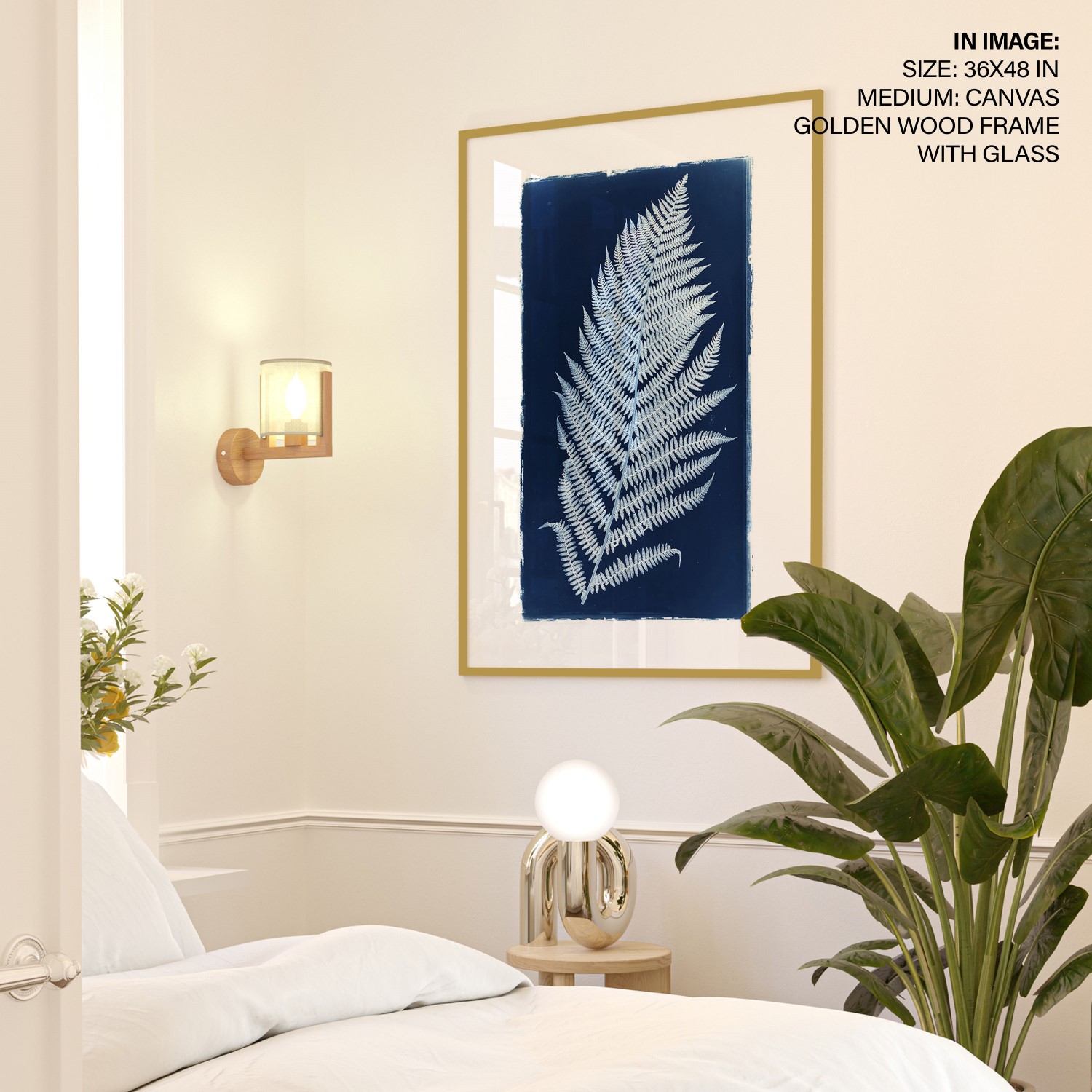
Leaf or botanical macro detail. The least “forest” and most decorative of the four, closer kin to a botanical print than a landscape. Best for: powder rooms, hallway walls, or anywhere green is wanted without asking a whole wall to do restorative work. Avoid: using it as the sole visual anchor in a room that genuinely needs the calming effect — treat it as trim, not as the fix.
BestOfBharat’s own catalogue splits roughly along these lines: the forest category carries most of the full-scene and canopy pieces, mountains covers a wider, more open version of the same idea for rooms that want scale without density, botanical holds the leaf-detail and single-specimen prints, and the green collection is the fastest way to filter by tone rather than subject once a client has already settled on a palette.
What this doesn’t fix
Art on a wall doesn’t add daylight, doesn’t clean the air, and doesn’t substitute for a real plant a client is willing to keep alive. If a room can plausibly get an actual window, genuine daylight, or living greenery, that should be the first recommendation — the framed print is what you reach for once those options are exhausted, not instead of considering them. That ordering is worth saying to a client outright: it’s a downgrade path for a room with real constraints, not a design trend to lead with.
It’s also worth being clear about the ceiling on all of this. None of the research above promises a measurable change in stress, blood pressure, or productivity from hanging a picture. What it supports is smaller and more defensible: a room with a quiet nature image gives the eye a better place to land than a room without one, and that’s associated with easier attention, not a treatment for anything. Oversell it and the first sceptical client will find the gap between the claim and the study in about four minutes.
Read this alongside
We set out the wider case for how colour and placement shape a room’s mood in our colour psychology guide, room by room — this piece is the deeper, trade-facing version of the one channel inside it with the strongest research behind it. If materials matter as much as motifs to your client, our breakdown of what’s actually in the paint and canvas covers the same evidence-first ground from a different angle. For the office brief specifically — reception walls, corridors, conference rooms — the fuller spec sits in how art affects a workspace. And once the image is chosen, our gallery wall starter guide covers the hanging-height and grouping mechanics that make it read as intentional rather than accidental.
Frequently asked questions
What is biophilic design, in plain terms? It’s the principle that people function better in spaces connected to nature — through daylight, plants, natural materials, or a view of greenery. The best-evidenced version is a real window with a natural view; art, planting and materials are what designers reach for once that’s not available.
Does biophilic wall art actually reduce stress? No study has tested framed art the way Ulrich tested real hospital windows in 1984, so that specific claim isn’t proven either way. What the surrounding research supports is a more modest, honest version: nature imagery is associated with easier, less effortful attention, which is useful in a room where people need to concentrate or wait.
Can a painting really replace a window in a windowless room? Not literally — nothing has shown a print produces the same effect as an actual view outdoors. What it can plausibly do is give the eye somewhere restful to land instead of a blank wall, a screen, or a fire door, which is the more defensible claim to make to a client.
What kind of nature image works best for a home office or workspace? Favour quiet over dramatic — a plain canopy, treeline or single tree rather than a busy, high-contrast jungle scene with a lot happening in the foreground. Attention-restoration research suggests images that hold the eye without demanding focus do more for concentration than images that compete for it.
Is one large forest piece better than a set of smaller nature prints? It depends on the room, not a fixed rule. A full-scene forest suits a windowless room or corridor with no competing light; single-tree or leaf-detail pieces suit tighter spaces, or rooms where a hint of green is enough without asking one image to do all the restorative work.