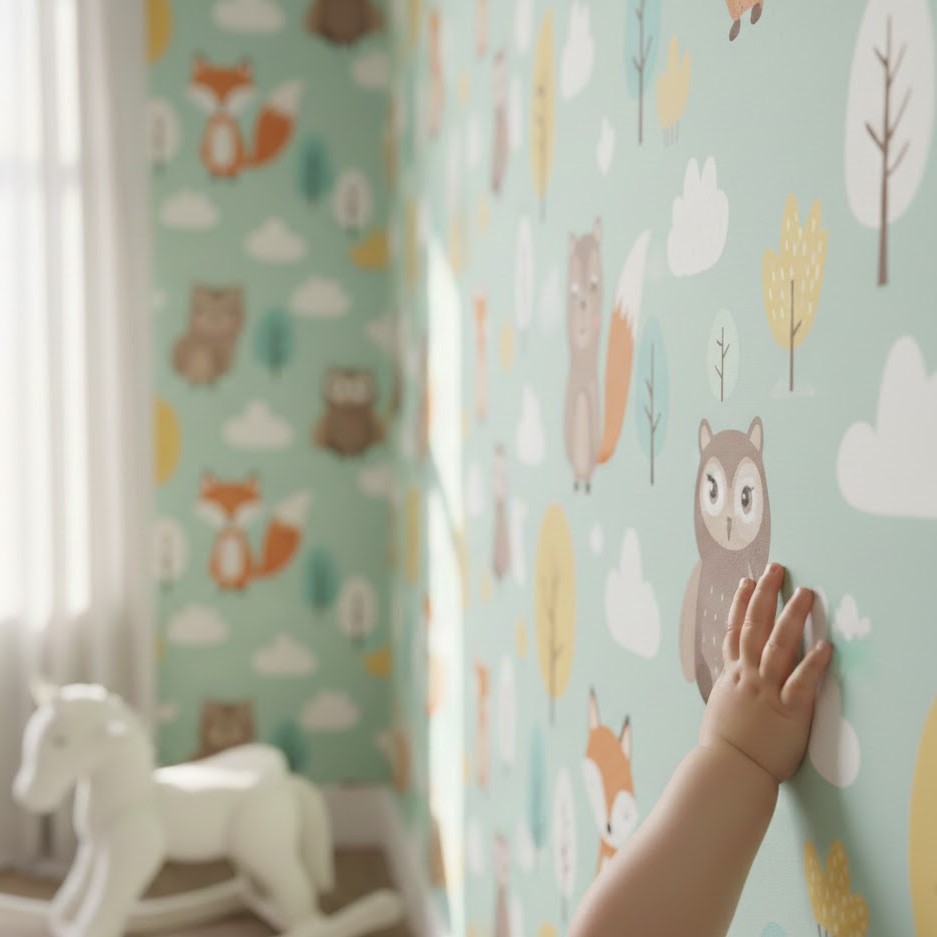
Most people spend weeks choosing the perfect wallpaper pattern or wall art for their home. Colour, texture, size, style — every detail gets scrutinised. But here is a question almost nobody in India asks: what is this product actually made of?
In Europe, governments have been asking that question for years. And they are banning the answers they are finding.
India, meanwhile, has no equivalent regulation for wall décor products. The wallpaper on your bedroom wall, the art print in your child’s nursery, the wall stickers in your living room — none of it is required to pass a single safety test before it reaches your home.
This is the story of what we found when we looked into it — and what we chose to do about it.
The Hidden Problem — What Is Actually In Most Wall Décor?
PVC and Vinyl — The 96% Problem
A major investigation by the US-based Ecology Center tested over 2,300 wallpapers from 11 different brands. The finding was staggering: 96% contained PVC (polyvinyl chloride) coatings.
PVC is not just another plastic. The US Green Building Council has called it “consistently among the worst materials for human health impacts.” Vinyl chloride — the molecule used to manufacture PVC — is classified as a known human carcinogen linked to lung, brain, and liver cancers.
But PVC on its own is rigid and brittle. To make it flexible enough for wallpaper, manufacturers add phthalates — chemical plasticisers that have been linked to over 350,000 heart-related deaths globally. The same Ecology Center study found that more than 50% of PVC wallpapers tested contained lead, cadmium, chromium, tin, and mercury.
These are not trace impurities. These are chemicals deliberately present in the products covering the largest surface area in your home.
And here is what makes PVC particularly deceptive: vinyl wallpaper does not “breathe.” It blocks air and moisture from passing through the wall surface. In humid Indian climates — particularly during monsoon — this creates a moisture trap between the wall and the wallpaper. To combat the inevitable mould growth, manufacturers add biocides (antimicrobial chemicals) to the wallpaper. These biocides disrupt hormone function, are associated with developmental and reproductive harm, and contribute to antibiotic resistance.
So PVC wallpaper creates a cascading chemical problem: the PVC itself contains phthalates and heavy metals. The impermeability requires biocides. The printing uses solvent inks that release VOCs. Layer upon layer of chemical exposure, all from one product on your wall.
The EU has already included PVC and its additives in its Restriction Roadmap — a formal list of hazardous chemicals earmarked for restriction. The European Chemicals Agency’s own investigation confirmed that alternatives exist for most PVC uses. Yet in India, PVC wallpaper remains the default option in virtually every home décor store.
VOCs — The Invisible Off-Gassing You Cannot See
Volatile Organic Compounds (VOCs) are chemicals that evaporate at room temperature and enter the air you breathe. They are released continuously from solvent-based inks, PVC coatings, and adhesives used in wall décor products.
Short-term exposure to VOCs can cause headaches, dizziness, eye irritation, and respiratory discomfort. Long-term exposure has been associated with damage to the liver, kidneys, and central nervous system.
The challenge with VOCs is that they are invisible and often odourless at low concentrations. By the time you notice a “new wallpaper smell,” the concentration is already significant — and that smell does not mean freshness. It means chemical off-gassing.
Formaldehyde — The Carcinogen In Your Walls
Formaldehyde is used in the resins that bind wood-based panels, in adhesives, and in certain paper treatments used for wall art and wallpaper. It is classified by the European Chemicals Agency as both carcinogenic (cancer-causing) and mutagenic (capable of damaging DNA).
Formaldehyde-based resins are found in MDF frames for wall art, in wallpaper substrates, and in the adhesives used during installation. At room temperature, formaldehyde off-gasses continuously — a slow, invisible release that can persist for months or even years after installation.
The health effects are dose-dependent but cumulative. At lower concentrations, formaldehyde causes eye irritation, sore throat, and coughing. At sustained exposure levels — the kind you get from living in a room with formaldehyde-emitting walls, sleeping there eight hours a night — the risks escalate to chronic respiratory disease and increased cancer risk. Children, the elderly, and individuals with pre-existing respiratory conditions are disproportionately affected.
The EU considers this serious enough to have passed binding legislation limiting formaldehyde emissions from wall coverings and furniture, effective August 2026. India has passed no equivalent legislation.
Why Indian Homes Are Especially Vulnerable
Here is what makes this particularly concerning for Indian households. Most homes in Mumbai, Delhi, Chennai, Hyderabad, and Bangalore are sealed apartments with air conditioning running eight or more months a year. Unlike European homes, which are often designed with ventilation systems and air exchange in mind, Indian apartments trap whatever your walls are releasing.
The air you breathe inside your home circulates past your wall décor hundreds of times a day. If those walls contain PVC, phthalates, heavy metals, and VOC-emitting inks, your indoor air becomes a slow accumulation of chemicals you never consented to breathing.
Wondering how wallpaper affects the air in your home? Read our detailed guide: Is Your Wallpaper Affecting the Air You Breathe?
Want to know what specific chemicals to watch out for? See: Does Your Wall Décor Contain Harmful Chemicals?
What Europe Is Doing About It (And India Is Not)
EU Regulation 2023/1464 — Formaldehyde Restrictions Effective August 2026
In July 2023, the European Commission published a landmark regulation setting maximum formaldehyde emission limits for a wide range of consumer products — including wall coverings, furniture, textiles, and wood-based panels.
The new limit — 0.062 mg/m³ — takes effect on August 6, 2026. After that date, any wall covering that exceeds this emission level simply cannot be sold anywhere in the European Union. This is not a guideline or recommendation. It is binding law across all 27 EU member states.
France’s Mandatory VOC Labeling
France has gone further. Every decoration product sold in the country — including every wallpaper and wall covering — must carry a mandatory VOC emission label, graded from A+ (very low emission) to C (high emission). This is not voluntary. Consumers in France can see, at a glance, how much their wallpaper will pollute their indoor air.
ECHA Investigation — Is a Full PVC Ban Coming?
The European Chemicals Agency (ECHA) was asked by the EU to conduct a detailed investigation into the risks posed by PVC and its additives. The resulting report found that PVC poses risks that “currently lack adequate control” and that alternatives are available to replace most uses.
Following this investigation, a coalition of environmental NGOs — including Health Care Without Harm Europe, ClientEarth, and Zero Waste Europe — formally requested the European Commission to ban PVC under the REACH regulation. Their argument: PVC’s characteristics fall exactly within the scope of what must be restricted under EU law.
India’s Regulatory Gap
India has none of these protections.
There is no equivalent of the EU formaldehyde regulation. No mandatory VOC labeling like France. No chemical safety framework like REACH for home décor products. No requirement for third-party testing of wallpapers, wall art, or any other wall covering.
Products that would be illegal to sell in Paris, Berlin, or Stockholm are freely available in every home décor store and e-commerce platform in India.
This is not a criticism of Indian regulation — it is a gap that has not yet been addressed. And until it is, the burden of ensuring product safety falls entirely on the consumer and the brands that choose to take responsibility.
Want to understand how European regulations work? Read: What European Safety Standards Should Your Wallpaper Meet?
The BestOfBharat Non-Toxic Standard
We did not wait for Indian regulation to catch up. We chose to meet the world’s strictest standards voluntarily — because we believe Indian consumers deserve the same protection that European consumers get by law.
Our Paper — Locally Sourced and Eurofins Lab Tested
Our wallpaper substrates and paper materials are sourced from Indian manufacturers — not imported from China, where quality control on chemical content has been repeatedly flagged by international regulatory bodies.
Every batch of paper is then independently lab-tested by Eurofins — a globally recognised third-party testing laboratory with accreditations across Europe, North America, and Asia. We do not self-certify. We submit to external scrutiny.
Our Inks — 9 International Certifications
The inks we use are water-based latex technology that carries one of the most comprehensive certification portfolios in the global printing industry:
| Certification | What It Verifies | Standard |
|---|---|---|
| UL GREENGUARD GOLD | Lowest chemical emissions into indoor air | Maximum wallcovering level |
| OEKO-TEX ECO PASSPORT | Every ink ingredient verified safe for human contact | Pre-qualifies for Standard 100 |
| EU REACH Compliant | No Substances of Very High Concern | EU’s master chemical safety law |
| French A+ VOC Rating | Very low emission — highest possible grade | Mandatory in France |
| German AgBB Compliant | Passes health evaluation for indoor building products | Germany’s VOC standard |
| CE EN 15102 | Meets European wallcovering construction standards | Mandatory in EU |
| ZDHC Roadmap to Zero Level 1 | Zero hazardous chemicals in manufacturing process | Manufacturing standard |
| No HAPs, Nickel-Free, Odorless | Zero Hazardous Air Pollutants, no allergenic nickel | Health and safety |
| EU Toy Safety EN 71-3, EN 71-9 | Safe even by children’s toy standards | Saliva, sweat, ingestion tests |
Each certification is explained in detail in our Non-Toxic Deep Dive series — linked at the end of this article.
Our Wood — Tested for Formaldehyde and VOC Emissions
For wall art frames and wall sculptures, the wood and MDF materials we use are tested for formaldehyde emissions and VOC levels. We do not use wood-based materials with untested resin content.
Why We Do Not Source From China
This is not nationalism — it is supply chain transparency. Chinese manufacturing has faced repeated international scrutiny for chemical content in consumer products, from lead paint in toys to formaldehyde in building materials. The US Consumer Product Safety Commission publishes a monthly China Product Hazard Bulletin tracking recurring safety issues in Chinese-manufactured consumer goods.
By sourcing paper and materials locally from Indian manufacturers, we maintain direct oversight of our supply chain. We know who makes our paper. We know what goes into it. And we verify it through Eurofins testing — because trust should be earned through evidence, not geography.
Is this safe for your baby’s nursery? Read: Is Your Nursery Wallpaper Safe for Your Baby?
How to Protect Yourself — A Buyer’s Checklist
5 Questions to Ask Any Wall Décor Brand
Before purchasing wallpaper, wall art, or any wall covering, ask the brand these five questions:
- What are your inks made of? Water-based or solvent-based? Do they carry any third-party certifications?
- Is your product PVC-free? If they cannot confirm this clearly, assume it contains PVC.
- Where are your materials sourced from? Can they trace their supply chain?
- Do you have independent lab reports? Not self-certification — third-party testing by an accredited lab.
- Which international safety standards do you meet? GREENGUARD GOLD? REACH? OEKO-TEX? If they cannot name specific certifications, be cautious.
Red Flags to Watch For
Pay attention if a brand:
- Uses the term “eco-friendly” or “safe” without naming any specific certification
- Cannot tell you whether their products are PVC-free
- Has no third-party lab testing reports available
- Sources all materials from unverified international suppliers
- Avoids questions about chemical content or ink composition
- Claims “organic” or “natural” inks without any third-party verification — these are marketing terms with no regulatory definition in India
- Lists certifications you cannot verify independently on the certifying body’s website
A useful test: email the brand and ask “Are your products EU REACH compliant?” and “Can you share your third-party lab reports?” The speed, specificity, and transparency of their response tells you more than any marketing claim on their website.
How to Read a Lab Report
A credible lab report for wall décor products should include: the name of the accredited testing laboratory (such as Eurofins, SGS, or TÜV), the specific tests performed (VOC emissions, heavy metals, formaldehyde), the test standards referenced (EN, ISO, or ASTM numbers), and clear pass/fail results against stated limits.
If a brand publishes lab reports, that is a strong signal of transparency. If they do not — ask yourself why.
Our Transparency Promise
We publish our Eurofins lab reports. Not summaries, not interpretations — the actual test results.
We do this because transparency is not a marketing tactic. It is a responsibility. When your product covers the largest surface area in someone’s home — the walls where they sleep, where their children play, where they breathe for hours every day — you owe them proof, not promises.
We publish our results. Ask other brands if they will do the same.
Deep Dive — Explore Each Certification
Want to understand what each certification means in detail? Explore our Non-Toxic Deep Dive series:
- Is Your Wallpaper Affecting the Air You Breathe? — GREENGUARD GOLD, French A+ VOC Rating, German AgBB, and Hazardous Air Pollutants explained
- Does Your Wall Décor Contain Harmful Chemicals? — EU REACH, ZDHC Zero Discharge, and why nickel-free matters
- Is Your Nursery Wallpaper Safe for Your Baby? — OEKO-TEX ECO PASSPORT and EU Toy Safety Standards for children’s spaces
- What European Safety Standards Should Your Wallpaper Meet? — CE EN 15102, the new formaldehyde regulation, and how all four safety layers work together
BestOfBharat is India’s only wall décor brand that voluntarily meets European safety standards across all product categories. Every wallpaper, wall art piece, wall sculpture, and wall sticker we produce is made with non-toxic, VOC-free materials — locally sourced, independently tested, and certified to international standards.