Indian Parents Check Everything - Except the Walls
Indian parents are among the most protective in the world. We check food labels for additives and preservatives. We filter and purify our drinking water. We choose organic produce where we can afford it. We spend weeks researching the safest car seat, the most reliable baby monitor, the best non-toxic feeding bottles. We read ingredient lists on baby shampoo and examine certifications on wooden toys.
But here is something almost no Indian parent thinks about: the walls of the room where their baby sleeps 12 to 14 hours every single day.
In Europe, wall coverings used in children’s spaces must meet the same chemical safety standards as the toys children put in their mouths. In India, there is no such requirement. A nursery wallpaper faces zero mandatory testing - no check for heavy metals, no evaluation of chemical content, no verification that the inks are safe for a child who will touch, lean against, and breathe inches from that surface for years.
We chose to meet those European child safety standards anyway. Here is what that means and why it matters for your baby.
What Is OEKO-TEX ECO PASSPORT and Why Should Parents Care?
What It Certifies
OEKO-TEX ECO PASSPORT is an independent certification system for textile chemicals, colourants, and auxiliaries - issued by the OEKO-TEX Association, one of the world’s most trusted names in textile safety.
What makes ECO PASSPORT rigorous is its two-step verification process. It does not just test the finished ink or chemical blend. It analyses whether the compounds and each individual ingredient within those compounds meet specific criteria for safety, sustainability, and regulatory compliance.
This is an important distinction. Many certifications test only the final product. ECO PASSPORT examines every component that goes into the formula - because a product can appear safe overall while containing individual ingredients of concern.
What Standard 100 Covers - Carcinogens, DNA-Damaging Substances, PFAS
ECO PASSPORT pre-qualifies chemicals for developing finished articles that comply with OEKO-TEX Standard 100 - the world’s most widely recognised and trusted textile safety certification. Standard 100 sets strict limits on:
- Carcinogenic substances (chemicals that cause cancer)
- Mutagenic substances (chemicals that damage DNA)
- Reproductive toxicants (chemicals that harm fertility and foetal development)
- Halogenated organic compounds (including chlorinated and brominated chemicals)
- Fluorinated substances (including PFAS - so-called “forever chemicals” that persist in the body and environment indefinitely)
- VOC-containing chemicals that affect indoor air quality
As of 2024, OEKO-TEX Standard 100 also explicitly requires products to be free of PFAS - the persistent synthetic chemicals that have become a major international health concern due to their accumulation in human blood and tissue.
What This Means for Your Nursery
Our inks carry ECO PASSPORT certification. This means every single ingredient - not just the final blend, but each component - has been individually verified for safety against the criteria that underpin the world’s most rigorous textile safety standard.
When you choose BestOfBharat wallpaper for your nursery, the inks on that wall have been scrutinised at a level of detail that most food products in India have not.
What Are EU Toy Safety Standards and How Do They Apply to Wallpaper?
EN 71-3 - Heavy Metals Released Through Saliva, Sweat, and Ingestion
EN 71-3 is part of the European standard for toy safety. It tests for the migration of heavy metals - specifically measuring how much of these metals is released when a material comes into contact with:
- Saliva - simulating a child mouthing or licking a surface
- Sweat - simulating prolonged skin contact
- Gastric fluids - simulating ingestion if a child swallows material
The heavy metals tested include lead, cadmium, chromium, barium, antimony, arsenic, mercury, and selenium. The limits are extremely strict - these standards are designed to protect the most vulnerable population (infants and toddlers) from the most dangerous exposure pathways (oral and dermal contact).
EN 71-9 - Organic Chemical Compounds
EN 71-9 goes beyond metals to test for organic chemical compounds in toy materials - including solvents, preservatives, plasticisers, and flame retardants. It evaluates whether these chemicals are present at levels that could harm a child through normal interaction with the product.
If It Is Safe Enough for a Toy, It Is Safe for a Wall
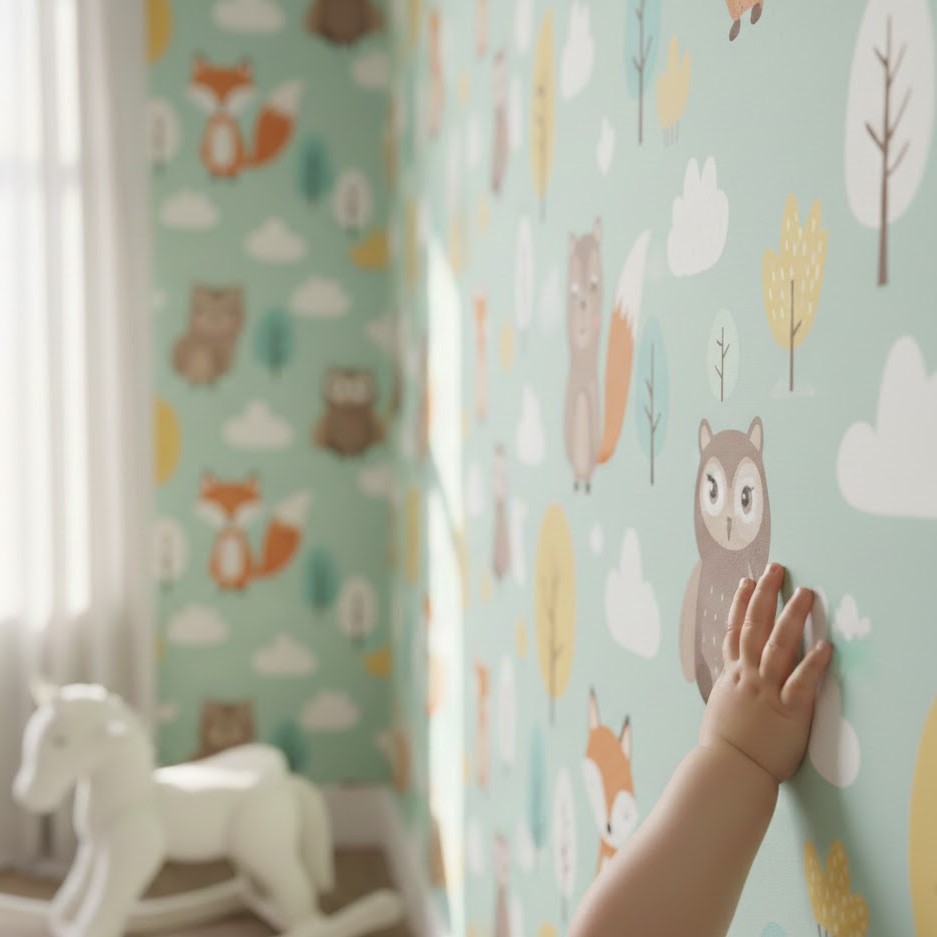
Think about how a baby or toddler interacts with their nursery. They press their hands flat against the wall while learning to stand. They lean their face against it during nap time in a cot pushed against the wall. They touch the wall and immediately put their fingers in their mouth. Some toddlers will literally lick the wall - any parent knows this.
A nursery wall is, in every practical sense, a surface that a child physically interacts with as intimately as any toy. Yet in India, toys must meet BIS safety standards - while the wall covering in the same room faces no testing requirement at all.
Our inks have been tested and demonstrated compliance with EN 71-3 and EN 71-9. If they are safe enough for a toy that a child puts in their mouth, they are safe for the wall of their nursery.
Additional Standards - ASTM F963-17 and Canadian SOR
Beyond European toy safety, our inks also meet ASTM F963-17 - the US toy safety standard - and Canadian SOR toy safety regulations. This means they have been evaluated against toy safety requirements across three major regulatory jurisdictions: the European Union, the United States, and Canada.
A Nursery Wall Decor Safety Checklist for Parents
When selecting wallpaper, wall art, or wall stickers for your baby’s room, use this checklist:
Is It PVC-Free?
PVC (polyvinyl chloride) is the most common wallpaper material globally - and one of the most hazardous. PVC wallpaper contains phthalate plasticisers, may contain heavy metals, requires biocide coatings to prevent mould (because it traps moisture), and releases VOCs throughout its lifespan. For a nursery, PVC should be avoided entirely.
Ask the brand directly: is this product PVC-free? If they cannot give you a clear yes, assume it is not.
Are the Inks Certified for Child Safety?
Look for specific, named certifications - not vague claims of “non-toxic” or “eco-friendly.” Credible child safety certifications for wall decor inks include OEKO-TEX ECO PASSPORT (or Standard 100), GREENGUARD GOLD, and compliance with EN 71 toy safety standards. If a brand cannot name the certifications their inks carry, be cautious.
Is the Paper Tested by a Third-Party Lab?
Self-certification by the manufacturer is not enough. Ask whether the product’s substrate - the paper or material itself - has been tested by an accredited third-party laboratory such as Eurofins, SGS, or Intertek. Independent testing provides a level of verification that internal quality checks cannot match.
Does the Brand Disclose Materials and Certifications?
Transparency is the simplest test of credibility. A brand that is confident in its product safety will openly discuss its materials, sourcing, ink technology, and certifications. A brand that deflects these questions, uses generic language, or cannot provide documentation has something it is not telling you.
Your Baby Deserves Walls as Safe as Everything Else in Their World
You would never feed your baby food without checking the label. You would never let them play with a toy you suspected contained lead. You would never put them to sleep on bedding you knew was chemically treated.
The walls of their nursery deserve the same scrutiny. They spend more time surrounded by those walls than almost any other surface in your home.
At BestOfBharat, we chose to meet the safety standards that European regulators designed specifically to protect children - not because Indian law required it, but because your child’s safety should not depend on where you live.
Your baby’s room air quality matters too. Learn how we protect it: Is Your Wallpaper Affecting the Air You Breathe?
Understanding what chemicals to avoid in all your wall decor: Does Your Wall Decor Contain Harmful Chemicals?
This article is part of the BestOfBharat Non-Toxic Standard. Read the full story