
Why Indoor Air Quality Matters More in Indian Homes
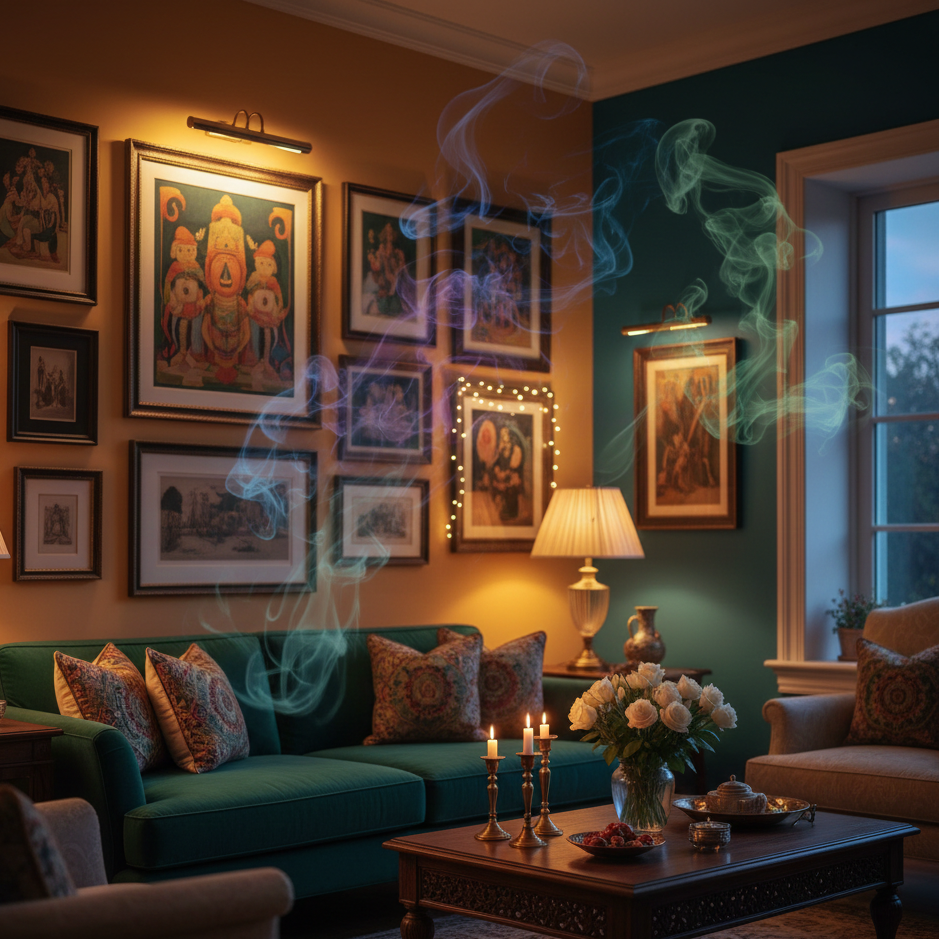
Consider how most Indian households actually live. In Mumbai, Delhi, Chennai, Hyderabad, and Bangalore, homes are sealed apartments with air conditioning running eight or more months of the year. Windows stay shut against heat, dust, and pollution. The air inside circulates in a closed loop — past your furniture, across your floors, and along every square centimetre of your walls.
Now consider this: wall decor covers more surface area than any other element in a typical room. More than the floor (which is often tile or stone). More than the furniture. If your wallpaper or wall art is releasing chemicals into the air, those chemicals are accumulating in the very space where you sleep, eat, and breathe.
In European countries, this is a well-understood problem with strict regulations. In India, there are no requirements for wall decor products to disclose what they emit. So how do you know if your walls are safe?
The answer lies in four internationally recognised certifications — each one testing a different dimension of indoor air safety.
What Is VOC in Wallpaper and Why Does It Matter?
VOC stands for Volatile Organic Compound — a category of chemicals that evaporate at room temperature and enter the air as invisible gases. Common VOCs found in wall decor products include formaldehyde, benzene, toluene, and xylene.
The sources are varied: solvent-based printing inks release VOCs during and after application. PVC coatings on wallpaper continuously off-gas phthalates. Adhesives used in manufacturing and installation add their own chemical load.
What makes VOCs insidious is that many are odourless at low concentrations. You may not smell anything, but the chemicals are still present — accumulating in your sealed, air-conditioned home, day after day.
Short-term effects of VOC exposure include headaches, dizziness, eye and throat irritation, and nausea. Long-term exposure has been linked to damage to the liver, kidneys, and central nervous system. Some VOCs — including formaldehyde — are classified as known carcinogens.
The “new wallpaper smell” that many people accept as normal? That is not freshness. That is VOC off-gassing you are inhaling.
What Does GREENGUARD GOLD Certified Mean for Wallpaper?
What GREENGUARD GOLD Tests
UL GREENGUARD GOLD is an independent certification issued by UL Environment — one of the most respected product safety organisations in the world. It tests the actual chemical emissions from a product in a simulated indoor environment, measuring what the product releases into the air under real-world conditions.
The testing is rigorous: products are evaluated against emission limits for over 10,000 individual VOCs, plus total VOC concentration limits, plus specific limits for formaldehyde and other high-concern chemicals. Products must demonstrate consistently low emissions over time — not just at the point of manufacture.
Why Maximum Wallcovering Level Matters
GREENGUARD GOLD certifies products at different application levels. The highest and most stringent level is full wallcovering applications — meaning products that cover entire walls in enclosed indoor spaces. This is significantly more demanding than certification for small indoor signage or limited-area displays, because wall coverings contribute emissions across a much larger surface.
Our inks are certified at this maximum wallcovering level. This means they have been tested and verified for the scenario that matters most: covering entire walls in the rooms where you live.
What This Means for Your Home
If your wallpaper or wall art carries GREENGUARD GOLD certification at the wallcovering level, the product has been independently verified to contribute minimal chemical load to your indoor air. It has been tested not by the manufacturer, but by a globally recognised third-party laboratory, against some of the most comprehensive emission standards in existence.
What Is the French A+ VOC Rating for Wall Decor?
The A+ to C Scale Explained
France operates a mandatory VOC emission labeling system called Emissions dans l’air interieur. Every decoration product sold in France — including every wallpaper and wall covering — must carry a label indicating its emission level on a scale from A+ (very low emission) to C (high emission).
This is not a voluntary eco-label that brands choose to display. It is a legal requirement. A wallpaper sold in any store in France without this label is breaking the law.
Why France Made This Mandatory
The reasoning is straightforward: people spend roughly 80-90% of their time indoors. The products that cover indoor surfaces — walls, floors, ceilings — directly determine the chemical quality of the air those people breathe. France decided that consumers have a right to know what their wall coverings are emitting, just as they have a right to know what is in their food.
What This Means for Your Home
Our inks are rated A+ — the highest possible grade, indicating very low emissions. This is the same rating required for wall coverings used in French hospitals, schools, and public buildings.
India has no equivalent labeling system. When you buy wallpaper in India, you have no way to know whether it would rate A+ or C on the French scale. You are purchasing blind.
How Does German AgBB Compliance Protect You?
What AgBB Evaluates
AgBB — the Ausschuss zur gesundheitlichen Bewertung von Bauprodukten (Committee for Health-related Evaluation of Building Products) — is Germany’s standard for evaluating VOC emissions from indoor building products.
Germany is known globally for the precision and rigour of its engineering and safety standards. The AgBB evaluation specifically measures how building products — including wall coverings — affect the health of people who occupy the spaces where these products are installed.
What This Means for Your Home
Our inks meet AgBB criteria for health-related evaluation of VOC emissions from indoor building products. This means they have been assessed against German health standards — among the most demanding in the world — and found to be safe for continuous indoor exposure.
Is New Wallpaper Smell Harmful? Understanding HAPs
What Are Hazardous Air Pollutants
Hazardous Air Pollutants (HAPs) are a specific category of air pollutants identified by regulatory agencies as causing or potentially causing serious health effects including cancer, reproductive harm, and neurological damage.
Many conventional printing inks — particularly solvent-based and UV-curable inks — contain HAPs as part of their chemical formulation. These pollutants are released during printing, during installation, and continue off-gassing after the product is on your wall.
Why Odourless Printing Matters
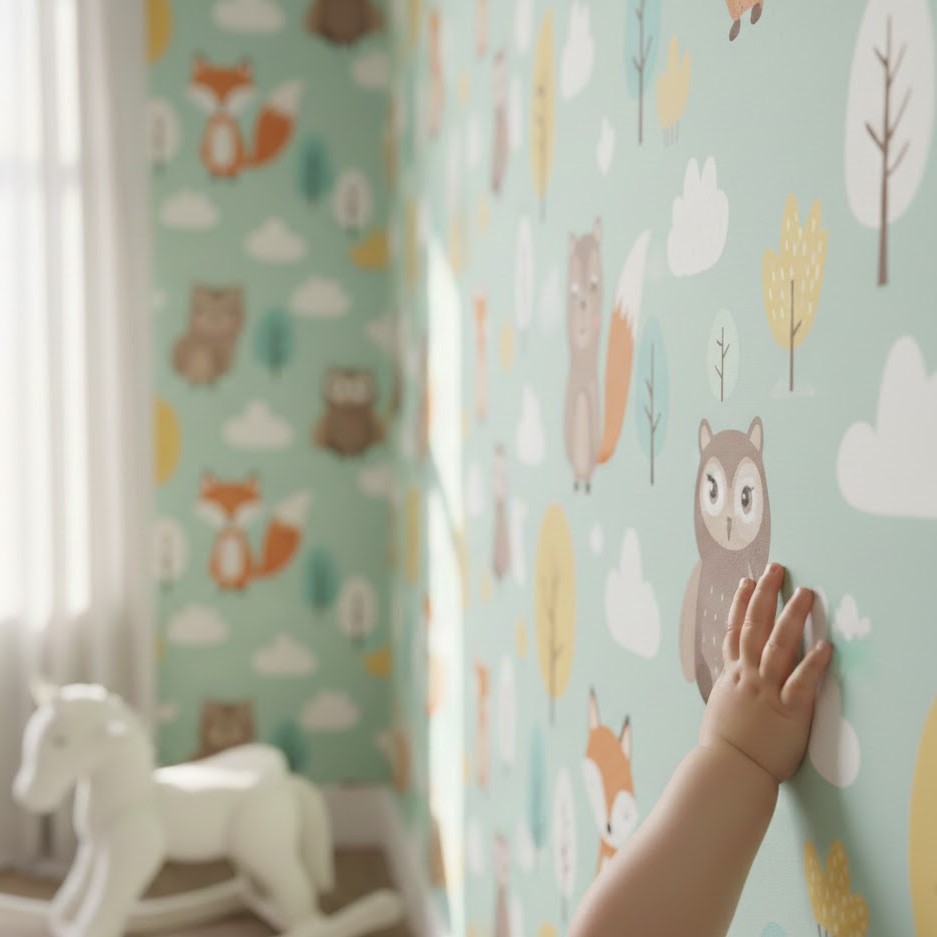
Our inks contain zero HAPs — not “low levels,” not “reduced,” but none. They produce odourless prints that are suitable for the most sensitive indoor environments, including hospitals, schools, and children’s rooms.
This is why our wallpapers have no chemical smell when you unroll them. There is no “airing out” period needed. No need to ventilate the room for days after installation. The product is safe from the moment it reaches your wall.
What This Means for Your Home
If you have ever noticed a strong chemical odour when unrolling new wallpaper, that odour was HAPs and VOCs entering your breathing space. Our products eliminate this entirely.
Is Wallpaper Safe for Asthma Patients?
For people with asthma, allergies, or respiratory sensitivities, indoor air quality is not an abstract concern — it is a daily health factor. VOC emissions from wall coverings can trigger bronchospasm, worsen existing respiratory conditions, and contribute to the overall chemical load that sensitised individuals struggle to process.
Wall decor that meets GREENGUARD GOLD, French A+, and AgBB standards simultaneously has been verified across three independent frameworks as contributing minimal chemical emissions to indoor air. For households with asthma patients, this layered verification provides a meaningful level of assurance that conventional, untested wall coverings simply cannot offer.
How BestOfBharat Meets All Four Air Quality Standards
Our wall decor products are not certified against one air quality standard — they meet all four:
- GREENGUARD GOLD at the maximum wallcovering level
- French A+ rating — the highest possible emission grade
- German AgBB compliance for indoor building products
- Zero HAPs with completely odourless prints
Each of these certifications tests a different dimension of the same question: what does this product do to the air you breathe? Together, they provide the most comprehensive indoor air quality assurance available in the global wall decor industry.
This article is part of the BestOfBharat Non-Toxic Standard. Read the full story: Is Your Wall Decor Toxic? What India Doesn’t Tell You
But what about the chemicals inside the product itself — not just what it releases? Does Your Wall Decor Contain Harmful Chemicals?