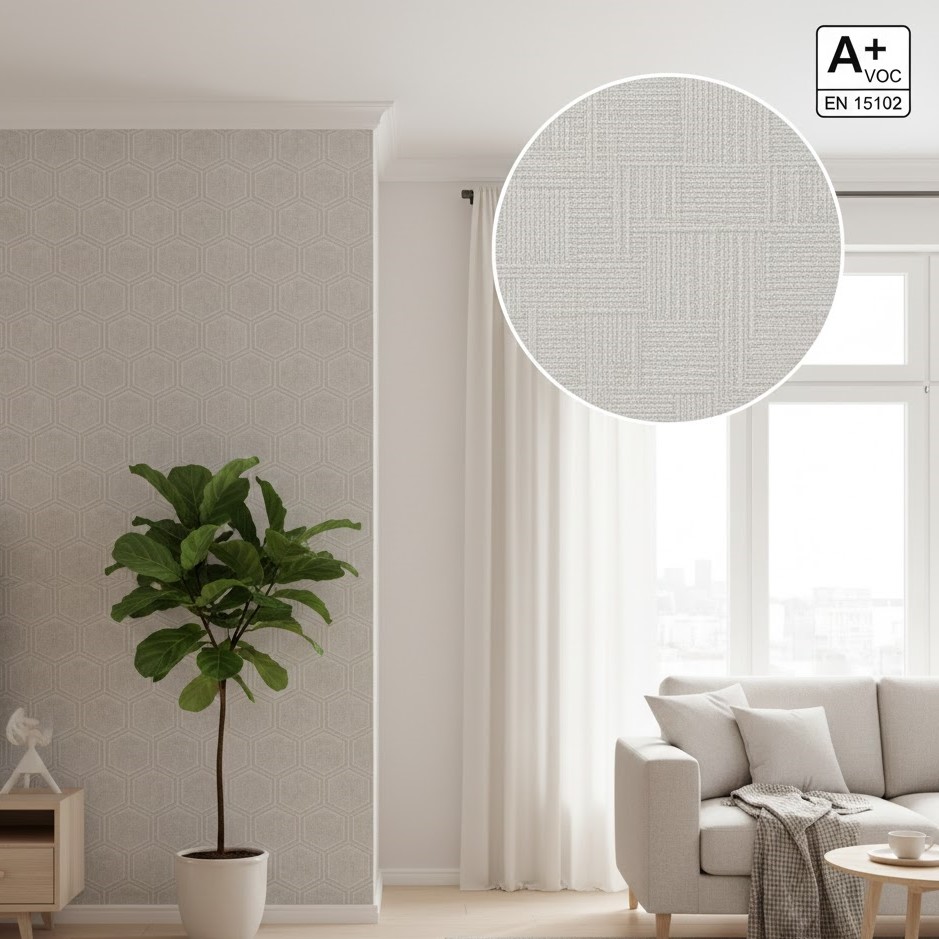
In Europe, You Cannot Sell Wallpaper Without Proving It Is Safe
Walk into any home decor store in Paris, Berlin, Amsterdam, or Stockholm and pick up a roll of wallpaper. Before that product reached the shelf, it was required — by law — to demonstrate compliance with chemical emission standards, construction product regulations, and health safety criteria.
Now walk into any home decor store in Mumbai, Delhi, or Bangalore and pick up a roll of wallpaper. That product was required to meet no safety standards whatsoever before it reached you.
This is not a minor regulatory difference. It is a fundamental gap in consumer protection. European consumers are shielded by multiple layers of mandatory safety standards. Indian consumers are on their own.
Understanding what those European standards require — and which brands in India meet them voluntarily — is the most practical step you can take to protect your home and your family.
What Is CE Marking EN 15102 and Why Is It Mandatory?
What EN 15102 Requires
CE marking is the mandatory product conformity mark for products sold within the European Economic Area. For wall coverings, the relevant standard is EN 15102 — a harmonised European standard that falls under the Construction Products Regulation (CPR) 305/2011/EU.
EN 15102 establishes requirements for wall coverings across multiple dimensions: reaction to fire (how the product behaves when exposed to flame), release of dangerous substances (what chemicals the product emits into the indoor environment), and other essential performance characteristics.
This is not a quality seal or a voluntary eco-label. It is a legal prerequisite. Without CE marking to EN 15102, a wall covering cannot be legally placed on the market in any EU member state.
Construction Products Regulation CPR 305/2011/EU
The Construction Products Regulation provides the legal framework under which EN 15102 operates. It establishes seven basic requirements for construction works, including safety in case of fire and hygiene, health, and the environment.
Under CPR, manufacturers must issue a Declaration of Performance for their products — a formal document stating how the product performs against the relevant harmonised standard. This declaration is legally binding and must be available to regulators and consumers.
What This Means — Every Wallpaper in Every EU Store Must Have This
The practical implication is absolute: if a wallpaper does not carry CE marking to EN 15102, it cannot legally be sold in the European Union. There are no exceptions for small brands, online sellers, or imported products. The standard applies universally.
Our products meet EN 15102 standards — the same legal baseline that is non-negotiable across 27 EU member states and the broader European Economic Area.
What Is EU Regulation 2023/1464 on Formaldehyde?
The New Emission Limits Taking Effect August 2026
In July 2023, the European Commission published Regulation (EU) 2023/1464 — a landmark restriction on formaldehyde and formaldehyde-releasing substances in consumer products. This regulation amends Annex XVII of the REACH regulation, adding a new entry (entry 77) that sets binding emission limits.
The key limit: articles placed on the EU market after August 6, 2026 may not emit more than 0.062 mg/m3 of formaldehyde under specified test conditions.
This is not a future proposal or a discussion paper. It is published, binding legislation with a specific compliance date — one that falls this year.
What Products Are Covered
The scope is broad. The regulation covers any article that releases formaldehyde, including wood-based products, furniture, wall coverings, foams, textiles, and leather products. For the wall decor industry specifically, this means wallpapers, wall panels, MDF frames for wall art, and any wood-based components in wall sculptures or decorative panels.
The regulation covers both formaldehyde itself and formaldehyde-releasing substances — the resins and binders used in manufacturing that break down over time and release formaldehyde gas. This is important because many products contain no “free” formaldehyde at the point of manufacture but release it gradually as their resins degrade.
Germany Aligning National Law to Match
Germany — which has historically maintained its own formaldehyde regulations — is aligning its national law to match the EU regulation. Germany’s Chemicals Prohibition Ordinance (ChemVerbotsV) will be amended, with national requirements being repealed on the same date the EU regulation takes effect: August 7, 2026.
This harmonisation underscores the seriousness of the regulation. Even Germany — which already had rigorous national standards — is integrating its framework into the EU-wide system.
Why This Matters for Indian Consumers
India has no formaldehyde emission limits for wall decor products. No testing is required. No labeling is mandated. A wallpaper or wall art product that would fail the EU’s 0.062 mg/m3 limit — and therefore be banned from sale across Europe — can be freely sold to Indian consumers without any disclosure.
The health risks of formaldehyde are not debated in the scientific community. It is classified as a known carcinogen and mutagen. The question is not whether formaldehyde in wall decor is harmful — it is whether your wall decor has been tested for it.
How European Safety Standards Work Together — The Four Layers
European wall decor safety is not a single standard — it is a layered system where each level addresses a different dimension of product safety. Understanding these layers helps you evaluate how thoroughly any wall decor product has been tested.
Layer 1: Legal Baseline — CE EN 15102
The foundation. Can this product legally be sold in Europe? Does it meet basic construction product requirements for fire safety and emissions? This is the minimum — the non-negotiable entry point.
Layer 2: Chemical Content — EU REACH and ZDHC
What chemicals are in the product? Are any Substances of Very High Concern present? Were hazardous chemicals used during manufacturing? REACH examines the final product; ZDHC examines the entire production process.
Learn more: Does Your Wall Decor Contain Harmful Chemicals?
Layer 3: Air Quality — GREENGUARD GOLD, French A+, and AgBB
What does the product release into your indoor air? How do those emissions measure against the world’s strictest air quality standards? This layer protects your breathing environment.
Learn more: Is Your Wallpaper Affecting the Air You Breathe?
Layer 4: Vulnerable Populations — OEKO-TEX and EN 71
Is the product safe for the most vulnerable people who will encounter it — specifically children? Have the inks and materials been tested against toy safety standards designed for infants who may mouth, touch, and ingest substances from surfaces?
Learn more: Is Your Nursery Wallpaper Safe for Your Baby?
Where Does India Stand?
An honest comparison between European and Indian regulatory frameworks for wall decor:
No CE Equivalent for Wall Coverings
India has no mandatory product standard equivalent to CE EN 15102 for wallpapers or wall coverings. There is no requirement for fire safety testing, emission testing, or a Declaration of Performance before a wall covering reaches the market.
No Mandatory VOC Labeling
Unlike France, India has no requirement for wall decor products to disclose their VOC emission levels. A consumer purchasing wallpaper in India has no way to know — from the product packaging or listing — whether that product emits high or negligible levels of volatile organic compounds.
No Formaldehyde Emission Limits
While the EU is implementing binding limits effective August 2026, India has no formaldehyde emission standards for wall decor, furniture, or building products aimed at consumer protection in indoor environments.
No Third-Party Testing Requirement
There is no Indian regulation requiring wall decor manufacturers to submit their products for independent laboratory testing. Self-certification — or no certification at all — is the norm.
This is not a criticism of India or Indian industry. It is a factual statement of where regulation currently stands. Many countries, including the United States, are behind the EU on some of these measures. But for Indian consumers who want the same level of protection that European consumers receive by default, the burden falls on choosing brands that voluntarily meet international standards.
How BestOfBharat Bridges the Gap
Meeting All Four Layers Voluntarily
BestOfBharat meets standards across all four layers of the European safety framework — not because Indian law requires it, but because we believe Indian consumers deserve the same protection.
Layer 1: Our products meet CE EN 15102 wallcovering standards.
Layer 2: Our materials are EU REACH compliant and our manufacturing meets ZDHC Roadmap to Zero Level 1.
Layer 3: Our inks carry UL GREENGUARD GOLD (maximum wallcovering level), French A+ VOC rating, and German AgBB compliance.
Layer 4: Our inks meet OEKO-TEX ECO PASSPORT requirements and EU toy safety standards EN 71-3 and EN 71-9.
For Commercial Projects — Certification Documentation Available
For hotel procurement managers, office facilities managers, and interior designers working on commercial projects: BestOfBharat can provide complete certification documentation for your procurement records. If your project requires material safety data sheets, third-party lab reports, or certification evidence for client presentations, we have these ready.
This is especially relevant for hospitality and commercial interiors where occupant health and safety documentation is increasingly expected — and where specifying certified, non-toxic materials is a meaningful competitive advantage.
Deep Dive — Explore Each Safety Layer
- Is Your Wallpaper Affecting the Air You Breathe? — GREENGUARD GOLD, French A+, German AgBB, and Hazardous Air Pollutants explained
- Does Your Wall Decor Contain Harmful Chemicals? — EU REACH, ZDHC Zero Discharge, and nickel-free verification
- Is Your Nursery Wallpaper Safe for Your Baby? — OEKO-TEX ECO PASSPORT and EU Toy Safety Standards
This article is part of the BestOfBharat Non-Toxic Standard. Read the full story: Is Your Wall Decor Toxic? What India Doesn’t Tell You
Shop all Wallpapers →