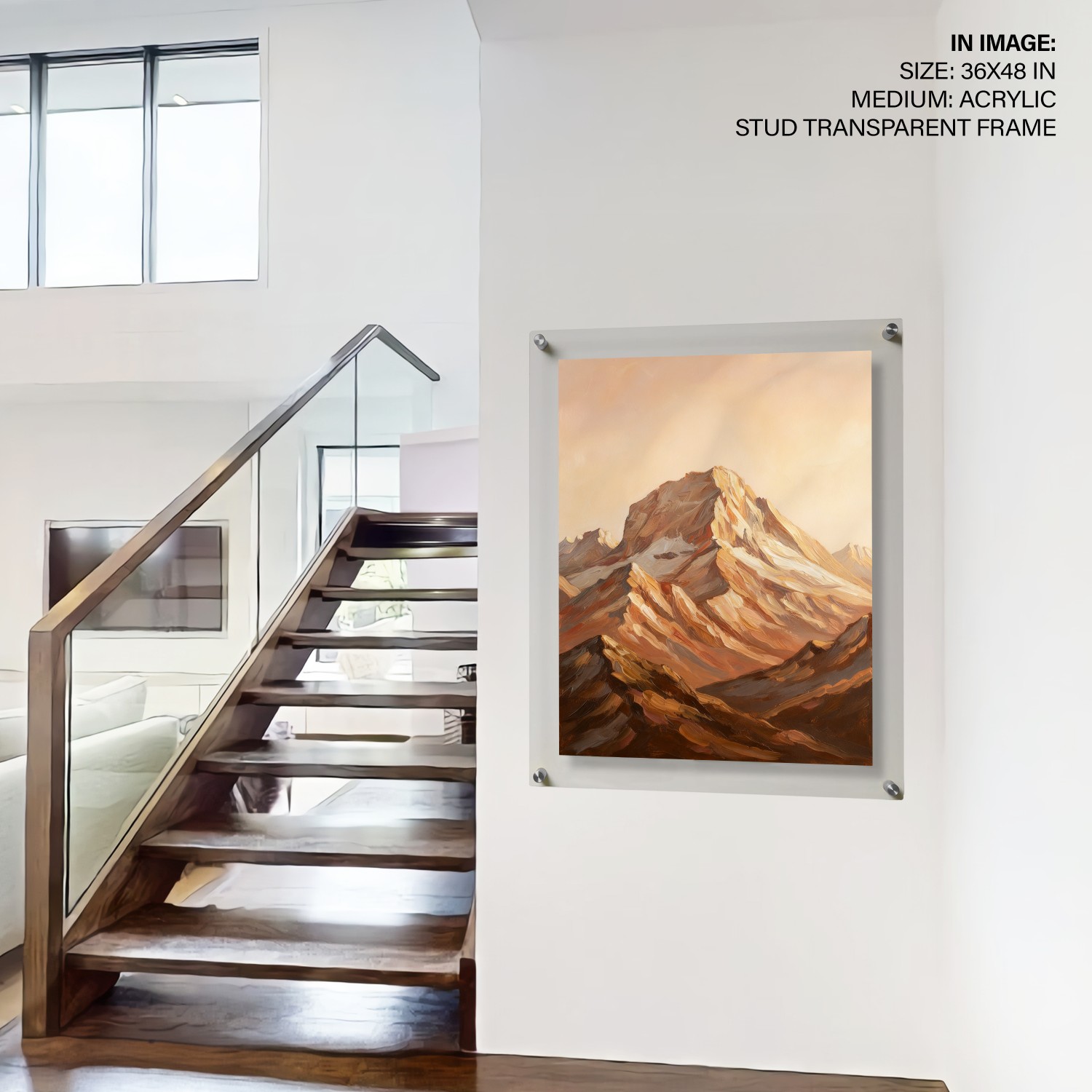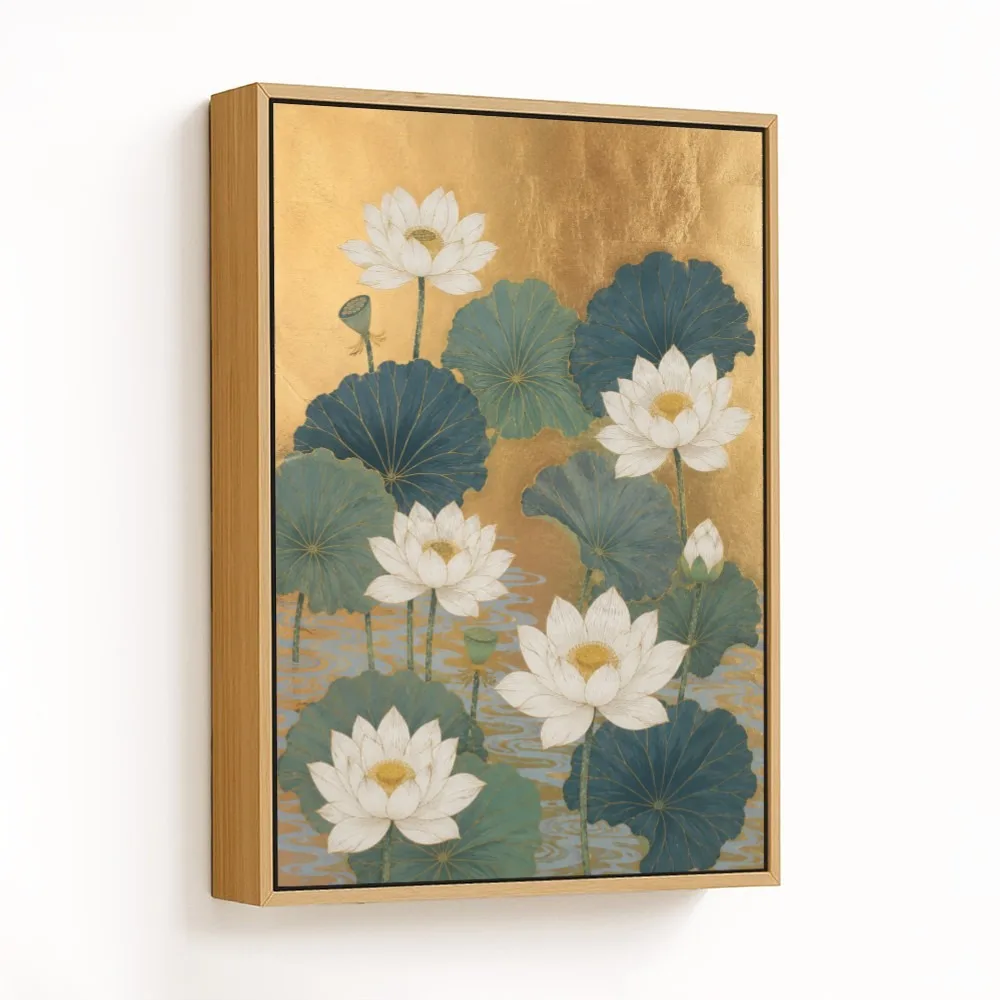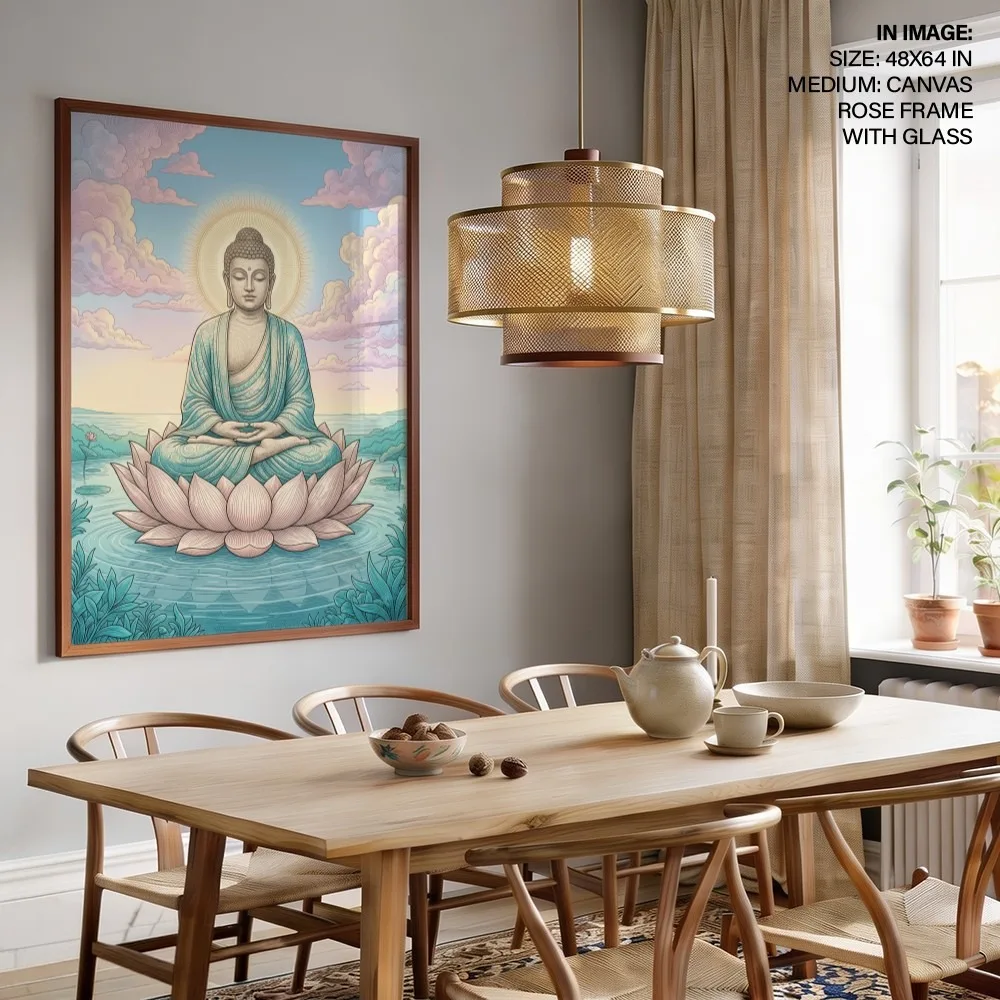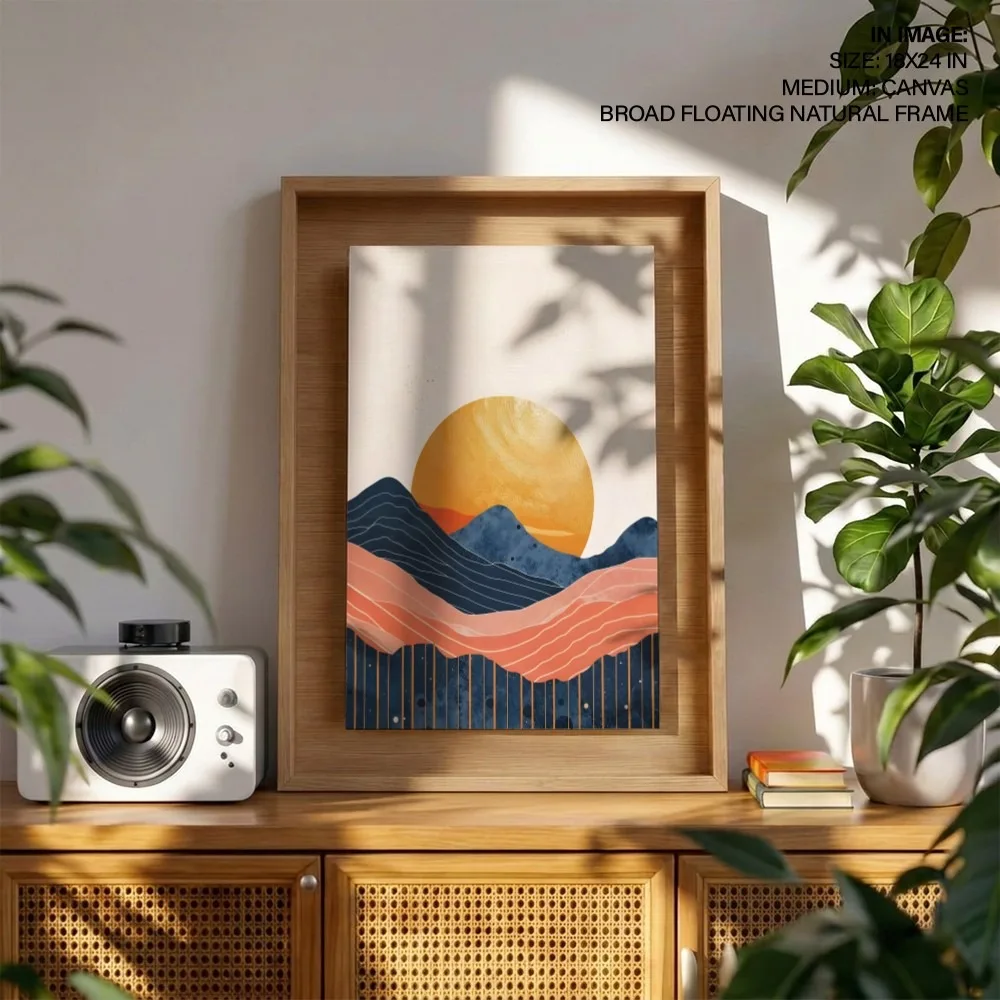
A rising sun painting belongs on the east wall. That is Surya’s own direction, the wall the real dawn reaches first, and a climbing sun hung there carries new beginnings, health and forward motion. It also works on the south wall, where a blazing sun feeds reputation, and in the south-east, Agni’s corner, where a warm luminary supports the household’s energy.
So far this matches every vastu guide you will read. Here is what they leave out: much of the art sold as “sunrise” was painted at dusk. Hang one on your east wall and you will have followed the direction rule exactly while hanging its opposite.
What a Rising Sun Means in Vastu
Surya is the one deity in the house you can actually point at. That directness is why the sun carries weight in vastu: the household already organises its day around him, from first light through the kitchen window to Surya Namaskar on the terrace.
A rising sun stands for aarambh, the beginning. Vitality, clarity, recovery, momentum. It is the image families choose when a child starts board exams, when someone takes a new job, when the keys to a flat change hands.
The rising part is where the meaning lives, and tradition has never blurred the two ends of the day. At Chhath Puja the sandhya arghya goes to the setting sun and the usha arghya to the rising one, on separate evenings and mornings, with different intentions. A setting sun is a fine painting. It is a different painting.
Which Wall Should a Sunrise Painting Hang On?
East first, by a wide margin.
East (Surya · the dawn wall) — new beginnings, health, study, fresh starts. Hang: a pale dawn sun just clearing the horizon. Keep off: any dusk or setting scene.
South (fire · fame) — reputation, recognition, professional standing. Hang: a blazing high sun in strong reds and oranges. Keep off: thin, washed-out dawns.
South-East (Agni’s corner) — warm household energy, appetite, vitality. Hang: a warm golden luminary, contained and steady. Keep off: cold grey-blue light.
West (the dusk wall) — closure, rest, fulfilment. Hang: a setting sun, correctly named as one. Keep off: selling yourself a sunset as a sunrise.
The east wall vastu guide covers everything else that belongs there. If your intent is recognition rather than a fresh start, the south wall guide explains why a blazing sun suits it and a pale dawn falls flat. For the kitchen corner, see Agni’s south-east wall, and the complete vastu wall art guide maps all eight directions.
Bedrooms are fine on the east wall, provided the sun is gentle rather than fierce.
Rising or Setting? Read the Light Before You Buy
Five tells, all applicable from a thumbnail.
Colour weight. Dawn light is thin: pale gold, lemon, rose, plenty of white left in the sky. Dusk carries the whole day’s dust, so it sits deeper, running orange to crimson to violet.
Any lamp means evening. Lit windows, a street light, boat lanterns, a diya on the ghat. Nobody switches lights on at sunrise.
Silhouettes. Heavy black shapes against a bright disc are a dusk device. Dawn scenes carry mist low over water instead.
What the people are doing. Nets going out, cattle leaving the village, a boat pushing off: morning. The same subjects heading home: evening.
Listing vocabulary. Twilight, dusk, afterglow, amber and “last light” mean evening. “Golden hour” happens twice a day and tells you nothing.
If you cannot tell within a few seconds, it is not a rising sun painting and should not go on an east wall. Placement runs on what the image shows, not on what the listing was titled.
The Seven Horses Connection
Surya crosses the sky in a chariot pulled by seven horses, driven by Aruna, the dawn himself. The seven are read as the colours inside white light and the days of the week. Konark’s temple is built as that chariot, wheels and horses cut in stone.
That shared origin is why the two are so often painted together, and why a seven-horse canvas with a sun breaking behind it reads as one idea.
Choose a plain sunrise for a bedroom or study, where you want the meaning without the motion. Choose the horses for a living room or entrance foyer, where you want visible drive. They carry placement rules of their own, which the seven horses painting vastu guide sets out.
Choosing Your Sunrise Artwork
Sun art splits into two families. Traditional Surya renditions centre the deity or his chariot, usually haloed, and suit a pooja corner or foyer where the devotional reading matters. Modern landscape dawns give you a horizon, a disc and little else, and sit better above a sofa or study desk.
Keep the palette honest to the wall. For an east wall stay pale: cream sky, soft gold disc, blue or green land. Save deep reds for a south wall, where that heat is the point.
Indian sitting rooms need more scale than people usually buy. Above a two-seater, 18x24 inches holds the wall; a sofa wall wants 36x48 or a pair; a study desk takes a single 12x18. Hang at eye level, centre 57 to 60 inches off the floor.
Our curated Sun collection is where to practise this. Open it and ask of each canvas whether that sun is climbing or dropping. The collection runs across the whole day, and each piece has its wall.
What to Avoid
- A setting sun on the east wall. Same palette, opposite meaning, and the most common mistake in the category.
- A sun half-swallowed by the horizon with nothing else to date the scene. Ambiguity is the problem.
- Storm dawns, or heavy grey cloud across the disc. A sun that is being blocked is not giving anything.
- A sun over barren ground, dead trees or ruins. The light should fall on something growing.
- A blazing red sun over the bed. Keep a bedroom’s east wall pale and low-key.
Frequently Asked Questions
Is a rising sun painting good for home?
Yes. A rising sun painting is among vastu’s most recommended images, standing for new beginnings, health and momentum. Hang it on the east wall for fresh starts, the south wall for reputation, or the south-east for warm household energy. Keep the sun clearly climbing and never obscured by cloud.
Which direction should a sunrise painting face?
A sunrise painting should hang on the east wall, facing into the room from Surya’s own direction. The south wall works when you want recognition and the sun is painted blazing, while the south-east suits Agni’s corner. Avoid the west wall, which belongs to the setting sun.
What does a rising sun painting symbolise?
A rising sun symbolises aarambh, the beginning. In vastu it carries Surya’s vitality, clarity and forward motion, which is why it is chosen for new jobs, new homes, exams and recovery from illness. The seven-horse chariot version adds speed. A setting sun symbolises closure instead.
Can a sunrise painting go in the bedroom?
Yes, on the bedroom’s east wall. Choose a gentle dawn in pale gold or rose rather than a blazing red sun, which is too active to sit above a bed. A misted landscape dawn works better here than a full Surya chariot. Keep the scale modest.
Bring the Right Sun Home
Tomorrow at seven, stand in front of the wall you have in mind and watch what the light actually does to it. Thin, pale, climbing. That is the light your painting should be carrying, and once you have seen it you will never mistake a dusk canvas for a dawn one. Browse the Sun collection with that picture in your head.