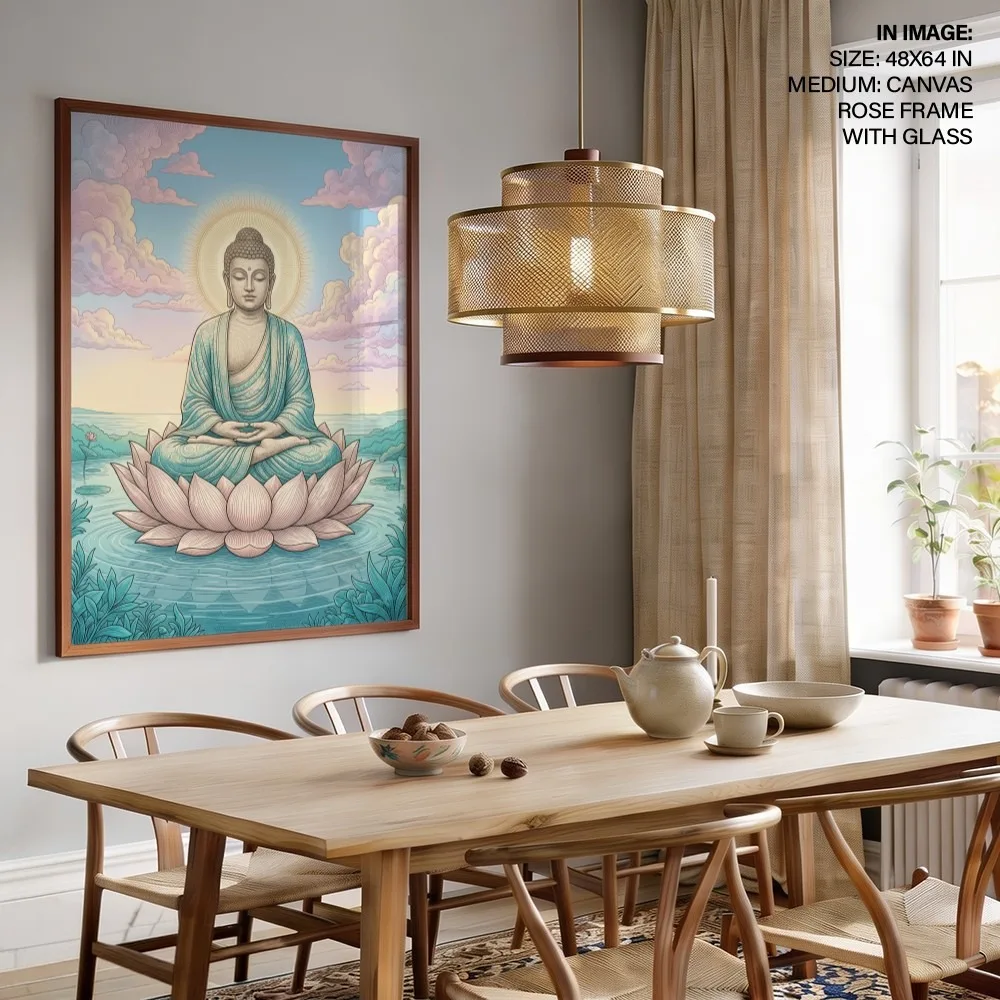
A meditating Buddha painting belongs on the north-east wall, the Ishan corner, with east as the only real second choice. Hang it facing into the room, raised above furniture height rather than propped on the floor, in a pale palette: white, cream or soft gold, never a dark, high-contrast portrait. Get the wall right, and the painting holds still while the room moves around it.
Buddha art sells faster than almost any other subject in this catalogue, and it is also the easiest one to misplace without noticing. A seven-horses canvas on the wrong wall looks wrong at a glance; a Buddha’s own stillness means a bathroom wall or the foot of a bed will not clash with it the same way, it will simply cancel the calm the image holds.
Buddha painting, at a glance:
North-east (Water & space · Ishan) — the primary wall. Stillness, clarity, the meditation and pooja corner. Hang: pale white, cream or soft-gold tones, facing into the room, raised above furniture height.
East (Air & sun · Surya) — the accepted alternate. A gentler version of the same growth energy, suited to a study or an entrance. Hang: soft dawn tones, bright rather than heavy.
Bedroom and bathroom — skip both, with one exception. A muted Buddha can sit on a bedroom’s east or north-east wall, never above the bed. Keep off: bathroom walls, floor level, and busy corridors.
Why Buddha Suits the Ishan Corner
Every wall in a vastu home answers to an element, and the north-east answers to two at once: water and space, the pairing that makes it the Ishan corner, the most sacred zone in the house. Our vastu paintings guide maps all eight directions on this logic. Water asks for stillness, space asks for openness, and a meditating Buddha is both in a single image: a figure that has stopped moving inside an uncrowded field of colour.
Ishan also governs clarity and wisdom, ruled by Jupiter, and a Buddha painting pictures the exact state the corner is named for: a mind that has settled. That is why tradition sites the pooja room or the meditation seat in the north-east, and why the Buddha belongs inside that corner, not just near it.
The Right Wall for a Buddha Painting
North-east is the wall to build around: face the painting into the room, not into a corner, and hang it above furniture height rather than close to the floor. A Buddha at ankle height, or propped against a skirting board “for now,” loses the raised, watchful quality the image depends on. Our north-east corner guide covers the rest of what suits this wall.
East is the real second choice, carrying its own version of the same idea: Surya’s morning light standing in for Ishan’s stillness, growth for clarity. A Buddha on an east wall reads as a gentler start to the day than a rising sun or a galloping herd would on the same wall, which is why it suits a study, a desk, or an entrance that opens to the morning light. The full logic for that wall is in our east wall vastu guide.
Buddha Statue or Buddha Painting?
The direction rules do not change when the Buddha is a statue rather than a canvas. A seated, meditating figure in dhyana mudra, in a pale material such as white marble or ivory-toned resin, wants the same north-east or east wall, facing into the room, raised on a clean shelf rather than the ground. Posture and material matter less than most shoppers assume; placement carries the weight.
Where a painting pulls ahead is the wall itself. A statue needs a surface: a console, a shelf, a corner kept dust-free. A painting needs only the wall, so it works where shelf space does not exist, and it scales to fill a stretch of wall a small statue never could. It also removes an everyday worry in busy homes: nothing to knock over. For a north-east corner with more window than open wall, a mid-size painting is usually easier to get right.
Choosing the Right Buddha Artwork
Palette carries more weight here than for almost any subject in this guide. A pale ground (white, cream, or brushed gold) keeps the north-east’s light quality intact. A dark bronze figure against black or deep maroon fights the corner. Between two similar pieces, let the background colour decide.
Scene matters less than tone. A Buddha under a bodhi tree, seated on a lotus, or set against a plain wash of colour all work equally well in vastu terms, so choose the scene you want to see each morning. What should stay constant is the mood: eyes closed or half-closed, hands settled in the lap, nothing mid-gesture. Keep the corner styled simply, a diya or a small plant, never crowded. The north-east rewards a light touch more than any other corner in the house.
A few pieces from our collection that keep to this palette:
Where Not to Place a Buddha Painting
Three places are wrong regardless of how good the painting is. Never a bathroom wall: the room’s constant water-and-waste use runs against everything a meditating figure stands for. Never the floor, propped against a skirting board “for now” — weeks of ankle-height storage undo the placement the piece depends on. Never a loud, high-traffic wall: a rushed corridor, or the wall behind a clattering kitchen.
The bedroom sits in between. Keep Buddha art out of a room built for rest, the same way you would keep out any devotional image asking for a stillness the room is not offering at 11pm. The one working exception is a muted, low-contrast Buddha on the room’s east or north-east wall, the side you wake to, never the wall behind your head. Our bedroom vastu guide covers the rest of what a bedroom will and will not take.
FAQs
Which direction should a buddha painting face?
Hang it on the north-east wall, so the painting faces south-west into the room; east is the accepted second choice. Both directions carry the calm, growth-friendly energy a meditating Buddha needs. Raise it above furniture height, never on the floor, and keep it off bedroom and bathroom walls.
Which buddha statue is good for home?
A seated, meditating Buddha in dhyana mudra, in a pale material like white marble or ivory-toned resin, follows the same rule as a painting: place it in the north-east or east, facing into the room, raised on a clean shelf rather than the floor. Direction matters more than material.
Can we hang buddha painting in the bedroom?
Better not to, as a rule: a bedroom runs on rest, and most Buddha art is too luminous for the wall behind sleep. The exception is a muted, low-contrast Buddha on the room’s east or north-east wall, the side you wake to, kept off the wall behind the headboard.
Is buddha painting good for the living room?
Yes. A living room can take a larger, more radiant Buddha than a bedroom can, especially near the entrance or a meditation corner on a north-east or east wall. Keep it facing into the seating area, raised well above sofa height, in a pale rather than a dark, heavy palette.
A Buddha painting rewards exactly the kind of attention its subject is practising: get the wall, the height and the palette right, and the piece holds its calm for as long as it hangs there. Start with the north-east corner if your home has one, and choose a pale ground over a dark one:
Browse all 18 designs in the Meditating Buddha collection, each made to your wall size, or start from the vastu wall-art collection for the rest of the house.