As per vastu, a seven horses painting belongs on the south wall, where it drives fame and career recognition; east (for growth and fresh starts) and north (for wealth flow) are the two sound alternates. In every case the horses should gallop forward, facing into the room, never out toward a door or window. This guide settles the seven horses painting vastu direction in the house that other pages hedge on, then covers what the seven horses actually mean, the rules the image itself must follow, where the painting should never hang, and how to choose the right size, frame and finish for a real Indian wall, across the 30+ designs in our Seven Horses collection, printed and framed in India.
What the Seven Horses Painting Means (and Why Seven)
The meaning starts with Surya, the sun god, whose chariot is drawn across the sky by seven horses. That single image is why this painting carries weight in an Indian home: the horses are the sun’s own power set in motion.
The number is deliberate. Seven maps onto the seven days of the week, the seven colours the sun splits into, and, in yogic thought, the seven chakras. So seven horses read as one full, unbroken cycle of energy rather than a random herd.
What people are pointing at when they call it a lucky seven horses painting is that steady forward drive. Horses stand for speed, stamina and the refusal to stop; seven of them galloping together stand for progress that holds its momentum. It is the reason the painting hangs behind so many desks and above so many sofas in homes chasing a promotion, a business breakthrough, or simply a household that wants to feel like it is moving ahead. Calling it lucky undersells the seven horses painting meaning: the artwork rewards a home already in motion and gives that drive a direction. Those are the benefits it is really hung for.
7 Running Horses Painting Vastu Direction in House
Place a seven horses painting on the south wall. South is ruled by fire (Agni) and governs fame, reputation and career standing; seven galloping horses are pure solar fire. Fire meets fire on exactly the wall you most want to be noticed from, which is why south is the primary placement and not a matter of taste. It is also the rule our vastu paintings for home guide sets for the whole house: the ruling element of a wall decides what hangs there.
| Wall | What it activates | When to choose it |
|---|---|---|
| South (primary) | Fame, recognition, career standing | The default — a living room, hall or office wall where you want visibility |
| East (alternate) | Growth, new beginnings, health | For fresh momentum, or when the south wall is taken — best for the rising-sun variant |
| North (alternate) | Wealth flow, opportunity, cash | When money and career openings are the goal (north is Kubera’s direction) |
Here is why the rankings you have read disagree with each other. Some say south, some say east, some insist north, and each is repeating half of the answer. The seven horses painting vastu direction is settled by one thing: the ruling element of the wall against the element of the artwork. Horses charged with the sun’s fire want a fire wall or a sun wall. South is fire itself, so it wins as the primary. East is the sun’s own direction, since Surya rises there, which makes it the honest second choice and the natural home for a seven horses painting with rising sun. North belongs to Kubera and moves wealth, so a household focused on money can hang it there, ideally a cooler-toned herd or a seven horses painting paired with water or a moonlit sky rather than a blazing sunrise, so the colour suits the wealth wall instead of the fire wall. Read that way, the contradiction disappears: the sources were each describing a different goal, not a different rule.
Which way should the horses face?
Inward. The horses must gallop into the room and into the home, never toward the exit. A seven horses painting hung so the herd charges at a door or window pushes your energy and your luck straight out of the house, which is the opposite of the point. Stand where you normally sit or enter, and the horses should be running toward you. On a shared wall next to a doorway, angle the artwork so the lead horse heads deeper into the room rather than out through the door. Direction of gallop matters more than the exact compass degree, and it is the rule most buyers get wrong.
When your south wall is already occupied
Plenty of Indian living rooms put the TV unit or a wide window on the south wall, leaving no clean space for art. Move to the east wall: it is the sanctioned alternate, and for the sunrise version it is close to as strong as south. Our east wall vastu paintings guide goes deeper on that wall, and the south wall guide covers the fire wall in full. What you should not do is force the painting into the nearest free spot regardless of room. A seven horses painting does not belong in a bedroom, a pooja niche or a passage simply because the wall was empty. If neither south nor east works in the room you had in mind, choose a different room over a wrong wall. Placement is the whole mechanism; ignore the wall rule and the painting stops earning its place.
The Rules of the Image Itself
The wall is only half the decision. The painting has to be the right painting, and a surprising number sold online quietly break the rules that make the seven horses work.
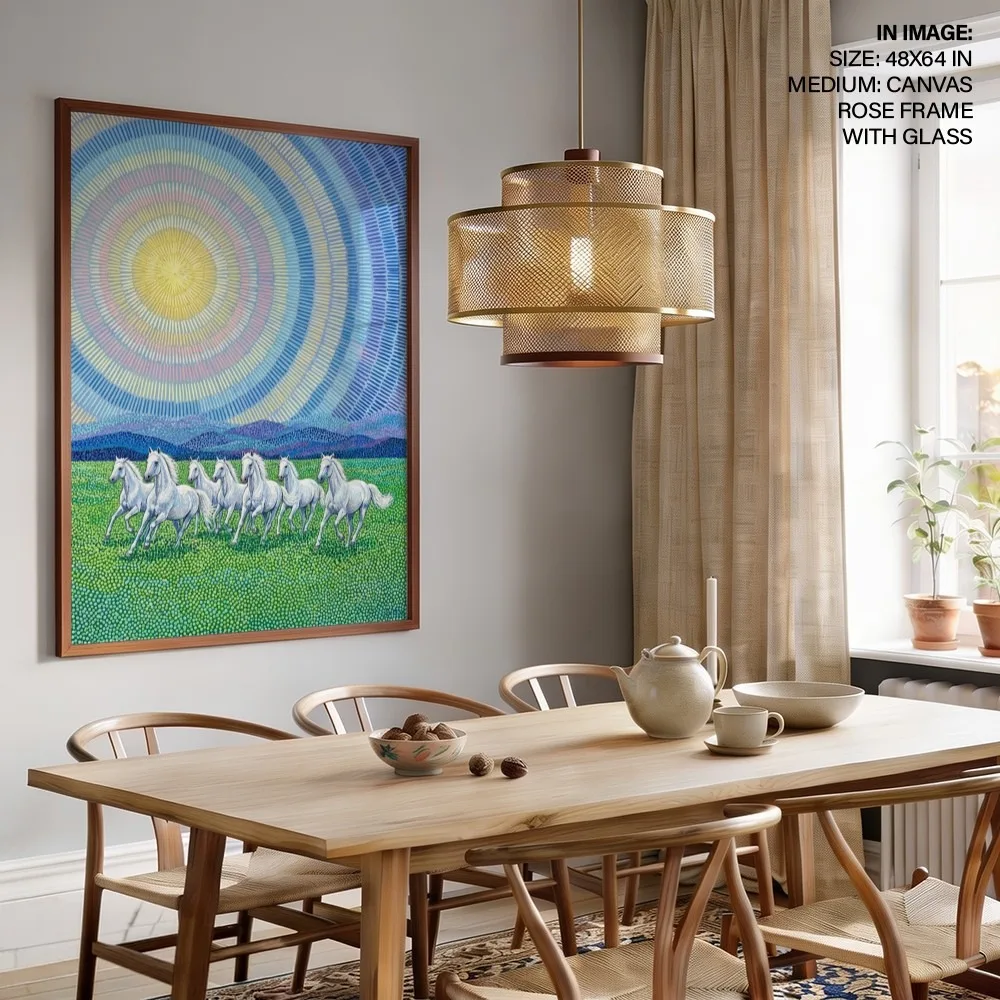
All seven horses should be fully visible, with no horse sliced off by the frame edge and no seventh animal merely implied. They should be galloping, hooves lifted off the ground, caught mid-stride rather than standing or grazing. The ground ahead of them must be open: no fence, no wall, no river blocking the run, and no reins, riders or harness holding them back. And the mood must be powerful, not violent. A rearing horse with pinned ears and bared teeth reads as struggle; what you want is strength and speed, heads forward, manes flying, a herd that looks like it is winning rather than fighting. When you shortlist a seven horses painting, check those four things before you check the price.
And it has to be seven. Listings offer five-horse and nine-horse versions, but vastu is specific about the count: seven, for the seven horses of Surya’s chariot. A five- or nine-horse print can be a handsome picture, yet it does not carry the same meaning, so if you are buying for vastu rather than for decor alone, count the horses first.
Background colours and what each activates
Colour changes what the painting emphasises, so match it to the wall and the goal.
Seven white horses read as peace joined with success. That calm, prestigious version is why a seven white horses painting is the safe pick for a formal living room or a director’s cabin. A sunrise or golden-orange background carries the sun’s own fire and suits south and east walls aimed at fame and fresh starts. Red and deep orange push hard on fire and fame energy, striking in a hall but best used in moderation and never in a bedroom. Blue and cool tones lean toward calm and steady wealth, which pairs naturally with a north wall. Keep the colour consistent with the rest of your vastu wall art scheme, so it agrees with the direction’s element instead of fighting it.
Sunrise or plain?
If you are choosing between a plain herd and a seven horses painting with rising sun, the sunrise version is the stronger vastu pick and, not by coincidence, the most popular variant we sell. The rising sun is Surya himself, the same deity whose chariot these horses draw, so a sunrise behind the herd doubles the solar energy and ties the artwork straight to new beginnings and rising fortune. A plain or monochrome herd still works and can suit a minimal, contemporary room; it simply leans on the horses alone rather than on horses plus sun. For a south or east wall, most homes are better served by the sunrise.
Where NOT to Hang It
The right painting on the wrong wall stops working, and some walls turn it against you.
Not the bedroom. Galloping horses are restless, high-movement energy, and a bedroom is meant for rest; the same drive that helps in a study disturbs sleep and, it is said, marital calm. Not the pooja room. That space is for your deities, and a seven horses painting is a vastu energiser rather than an object of worship, so it competes for an attention it should not hold there. Not a bathroom or store wall. Both are low, draining zones, and an energy painting hung there loses its benefit down the drain. And not facing the main door outward, where the herd runs out of the house and takes your luck with it. The safe zones are simple by comparison: living room, hall, home office, reception, and the cabin wall behind a working desk.
Choosing Size, Frame and Finish for an Indian Wall
This is where most guides stop and most buyers get stuck. You have picked the wall and the design, and now you have to choose a size and finish that actually fit the room. No ranking page tells you how, so here is the practical part.
Size by wall. Above a three-seater sofa, the artwork should span roughly 60 to 70 percent of the sofa’s width, as a single large canvas or a balanced set, hung so its centre sits near eye level when you stand, which usually lands the middle of the art around 57 to 60 inches off the floor. Over a console or sideboard, the same 60 to 70 percent rule holds against the furniture below. For a tall, empty feature wall or a staircase, go big: a large-format or panoramic seven horses painting earns a wall that would swallow a small frame. The common mistake is buying a 24-inch print for a wall that needed a 48-inch one, so when in doubt in an Indian living room, size up.
Canvas or framed. A stretched canvas gives a warm, gallery feel with no glare and suits contemporary rooms. A framed print with a mount looks more formal and sits behind glass, which is worth it in a dusty or high-traffic room, though glass adds reflection you will want to keep away from direct window light. For most homes, a slim frame in a finish that echoes the room — dark wood, champagne or black — is the low-risk choice. Seven-horse artworks also come as one wide panel or as a split set of three or five panels: a single panel reads cleaner on a busy wall, while a multi-panel set covers a very wide sofa wall without one enormous frame. With a split set, keep a steady two- to three-inch gap between panels so the herd still reads as one run.
Print quality. A ₹149 poster and a fine-art giclée canvas are both technically a seven horses painting, and they do not age the same way. Thin prints fade and cockle within a year in Indian humidity, while a proper canvas or fine-art print with UV-stable inks holds its colour for years. On the wall you look at every single day, the better print is worth the difference.
Every design in our Seven Horses collection is printed to your wall’s size and hand-framed in India, so you can match the direction, colour and format to the exact wall you have in mind.
Seven Horses at the Office or Shop
The seven horses painting vastu direction in an office follows the same logic as the home, tuned to the workspace. Hang it on the south or east wall of your cabin, ideally behind your chair, so it sits at your back as you work and faces whoever walks in: the classic placement of power behind the desk, signalling momentum and authority to the person across from you. For a shop or showroom, the seven horses painting direction of choice is the wall behind the cash counter or billing desk, again with the horses galloping inward, toward the stock and the till rather than out the shop door. In a reception or lobby, the same rule holds: hang it on the wall a visitor faces as they settle in, not on the wall behind them as they walk out. In either setting the message is the one the painting carries at home: forward drive, ambition, a business that means to grow. Keep it off a store-room or back-passage wall, and give it the wall people actually see.
Frequently Asked Questions
Which direction should a 7 horse face?
The horses should face into your home or room, galloping inward, never out toward a main door, window or exit. The painting itself belongs on the south wall for fame, with east and north as alternates. Inward-facing horses draw energy and opportunity in, while outward-facing ones send it out of the house.
What does a 7 horses painting symbolize?
Seven galloping horses symbolise speed, stamina, progress and unstoppable forward momentum. They carry the energy of Surya, the sun god, whose chariot they draw across the sky. In a home or office the painting stands for ambition that keeps moving: success, victory and steady growth in career, business and reputation.
Which color 7 horse is lucky?
White horses are the most universally lucky, reading as peace joined with success, which is why seven white horses are the safe choice for most homes. Sunrise and golden tones add solar fire for fame and fresh starts, while blue leans toward calm wealth. Match the colour to your wall’s direction for the best result.
Is it good to keep 7 horse painting at home?
Yes. A seven horses painting is considered highly auspicious and is one of the most recommended vastu artworks for an Indian home. Hung on the right wall (south, east or north) with the horses facing inward, it invites progress, recognition and prosperity. Just keep it out of bedrooms and pooja rooms.
Can I place a 7 horse painting in the bedroom?
No, avoid hanging a seven horses painting in the bedroom. The horses carry restless, high-movement energy meant to drive activity and ambition, which works against the rest a bedroom needs and is said to disturb sleep and marital harmony. Choose the living room, hall or home office instead for the same painting.
What do the 7 horses in Surya’s chariot represent?
The seven horses of Surya’s chariot represent the seven colours of sunlight and the seven days of the week, together making up the sun’s complete cycle of energy. In vastu they carry that solar power into your home, which is why a seven horses painting is tied to fame, vitality and forward progress.
Get the direction right, insist on all seven horses running forward into the room, and a seven horses painting becomes one of the most dependable vastu additions you can make to a home or a workspace. Explore the Seven Horses collection below to find the wall size, background and frame that suit your room.