For seven years, Indonesia printed a Hindu god on its money. The 20,000-rupiah note carried Ganesha on the left, beside Ki Hadjar Dewantara, the man Indonesians call the father of their national education.
It was issued in 1998 and printed until 2004, in the world’s largest Muslim-majority country. Nobody there found it strange.
He is on a campus gate in Bandung too. The Bandung Institute of Technology, Indonesia’s oldest technical university, sits at an address that reads Jalan Ganesha 10. Its emblem is taken from the Ganesha statue by the clock-tower gate.
The broken tusk in that emblem is read, in the institute’s own account, as the willingness to give something up for the sake of knowledge.
Buddhists and Hindus across Asia did not merely tolerate Ganesha. They gave him altars, festivals and their own names for him. And almost every tradition that took him in asked him for something different.
How Ganesha Left India Without an Army
No Indian army carried him. Two things did: Buddhism, which took him along as it moved, and merchants, who wanted somebody reliable on the route.
The earliest securely dated Ganesha sculptures outside India come from southern Cambodia in the seventh century. The Cham, in what is now central Vietnam, were carving him in the same period.
By then Hinduism and several forms of Buddhism had been moving through Southeast Asia for generations. He arrived as part of that traffic rather than ahead of it.
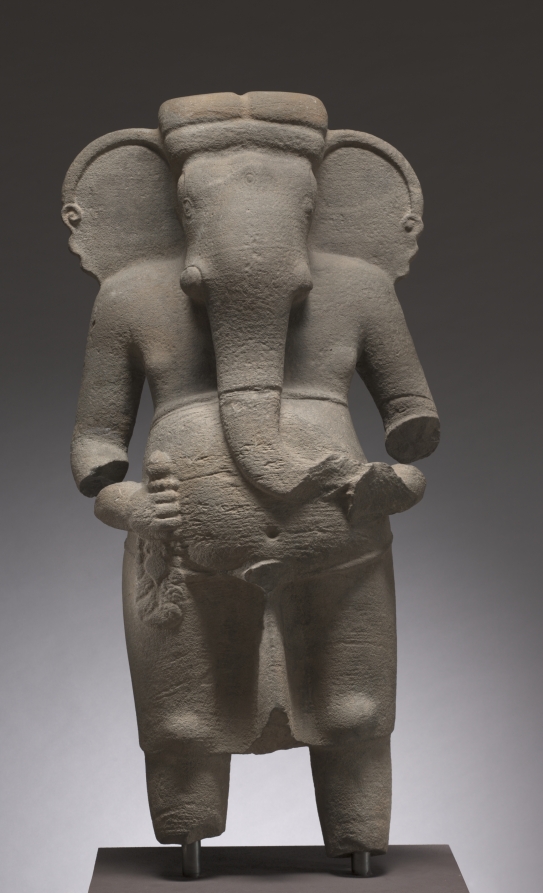
The direction is worth getting right. The marble Ganesha from Gardez in eastern Afghanistan was long treated as the earliest of these. It is now dated to the eighth century — about a century after the Cambodian and Cham carvings, not before them.
So this is not one wave spreading outward from a single point on a single date. It is a figure who kept being picked up, over centuries, by people who already had gods of their own.
Ganesha in the Himalayas, Thailand and Indonesia
Here is the pattern that makes him unusual. A deity who travels usually arrives with everything he already does. Ganesha arrived, and each tradition asked him for something of its own.
Ganesha in Himalayan Buddhism: Ganapati, asked for wealth
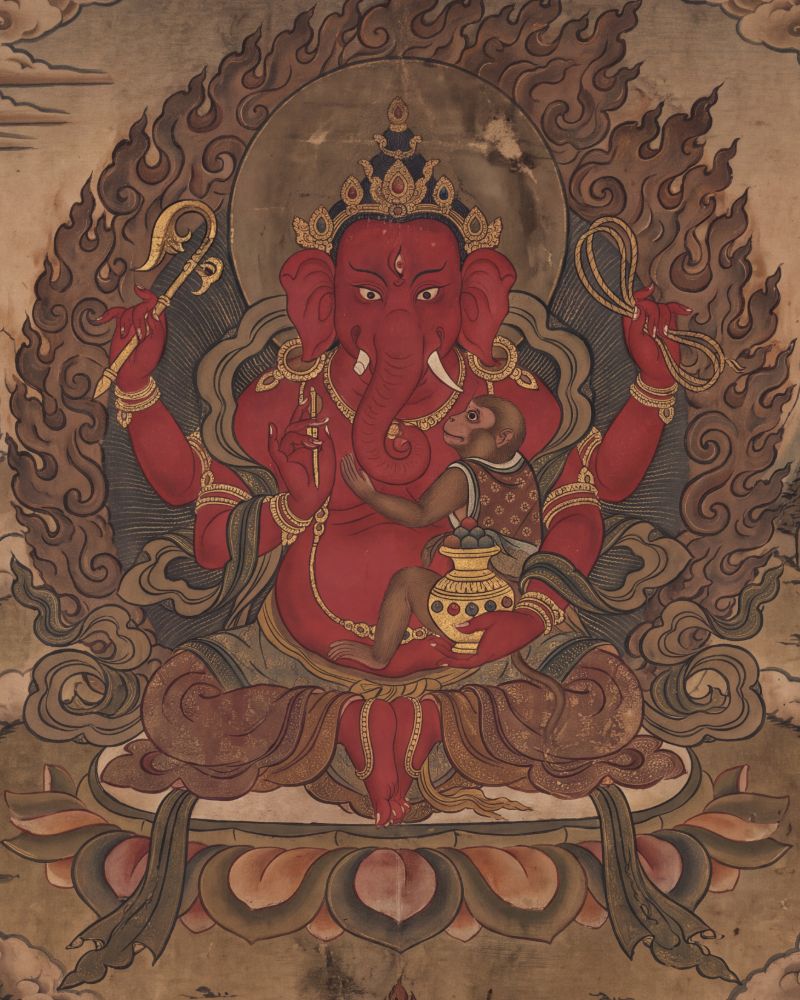
Himalayan Buddhist practice knows him as Ganapati. In the Nyingma treasure traditions — Nyingma being the oldest of the Tibetan Buddhist schools — he is invoked chiefly for wealth.
The red form is shown with a hook and a lasso, a monkey attendant, and a vase of jewels at his side. He is asked to fill a treasury, not to clear a road.
Ganesha in Thailand: Phra Phikanet and the Fine Arts Department
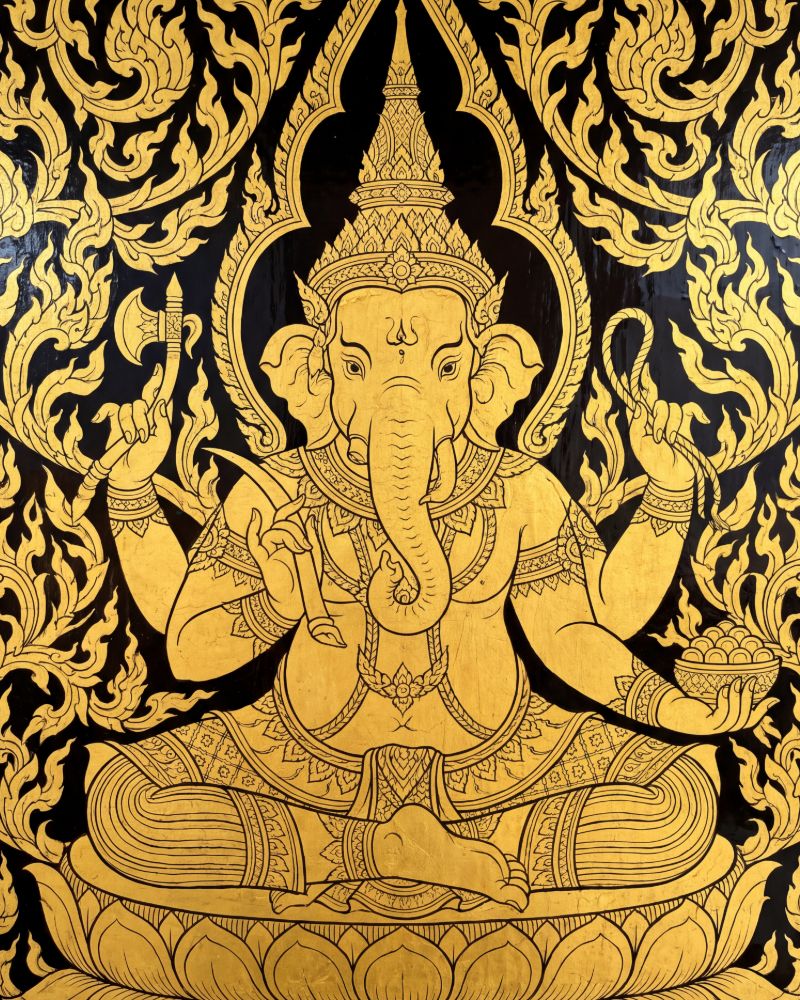
Thai Buddhists know him as Phra Phikanet. Thailand’s Fine Arts Department uses a seal of Ganesha as its emblem, because he is the patron of the arts.
The department is a real arm of government. It sits under the Ministry of Culture and has looked after Thai heritage since 1912.
Thai artists and performers honour him before beginning new work, in the teacher-homage rite called wai khru.
Ganesha in Indonesia: the banknote and the Bandung gate
Indonesia asked him for learning. That is why the note pairs him with an educationist, and puts a classroom of Taman Siswa — the school system Dewantara founded — on the reverse.
It is why a technical university put him on its gate.
None of this is what he does in India. India kept something else for him.
Ganesha in Japan: Kangiten, the Deity Nobody Sees
Japan goes furthest from anything an Indian reader would recognise.
There he is Kangiten, also called Shōten. In most temples that hold him, nobody sees him. The image is a hibutsu, a concealed icon, kept closed inside a small shrine cabinet and never displayed.
Where the form is described in the esoteric tradition, it is not the single elephant-headed figure familiar in India but a pair, male and female, standing in an embrace. The secrecy and the iconography are connected.
What worshippers bring instead is a daikon radish. In Japanese practice it stands for one of the three poisons given up: hatred. The forked white radish has become the emblem of Kangiten temples.
At Matsuchiyama Shōden in Asakusa, the radish is carved into the fittings and the railings. You find the crest everywhere on the grounds and the deity nowhere.
The other great Kangiten temple is Hōzan-ji, on Mount Ikoma in Nara. Tankai finished it in 1678 and installed the Kangiten image that year.
Through the Edo period, Osaka’s merchants climbed the mountain to ask him for good trade. They still go. The sweets left there are called kangidan, and they descend from modak.
Ganesha in Nepal, China and Myanmar: New Forms, New Names
Travel changed his body as well as what was asked of him.
Five heads, and a lion instead of a mouse. Heramba Ganapati has five elephant heads — four facing the compass points, one looking up — ten arms, and a lion as his mount. The form started in India. It stuck in Nepal, among the Newars, the Kathmandu Valley’s oldest community. Their Buddhist and Hindu practice both treat a five-faced icon as powerful protection.
Roadside shrines, and four temples visited as one circuit. The Kathmandu Valley keeps Ganesha shrines on its street corners. Four Binayak temples are visited as a set: Ashok, Chandra, Surya and Jal. Binayak is the local form of Vinayaka, one of his oldest Sanskrit names.
A new reading in Chinese. In Chinese Buddhism he is Huanxi Tian, the deva of bliss. It is the same two characters Japan reads as Kangiten.
A name that outlived the statue. The Burmese Maha Peinne comes from the Pali Maha Vinayaka, “Great Vinayaka”. It is the same name cut into the marble at Gardez, still spoken a thousand years later and a continent away.
The Gardez Ganesha, Still Worshipped in Kabul
The Gardez marble is not in a museum.
He carries a Sanskrit dedication, cut in Siddhamatrika — the north Indian script of the period. It records the installation of an image of Maha Vinayaka by a king called Shahi Khingala. He is attributed to the Turk Shahi rulers of Kabul, in the eighth century.
And he stands in the Dargah Pir Rattan Nath, a working Hindu shrine in Kabul that carries a Sufi word in its name.
An eighth-century marble image, dedicated by a king whose name survives in Arabic sources as well as Sanskrit ones, has no accession number and no glass case. People still bring him flowers.
They do so in a city where decades of war and targeted attacks have reduced the Hindu and Sikh community that kept the shrine to a remnant of what it was.
Every other tradition here asked Ganesha for something particular. Kabul asked him for nothing in particular. It just kept asking.
In India, Ganesha Goes First
Each tradition here gave him something to be. Wealth. The arts. Learning. Protection. A deity kept behind a closed door.
India gave him the opening.
He is not the god of one thing here. He is the one you address before you address anyone else — before a wedding, before a new ledger, before a journey, before the first line of a manuscript. Before the other gods.
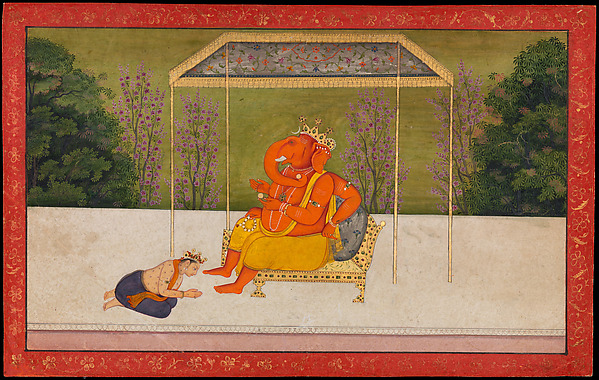
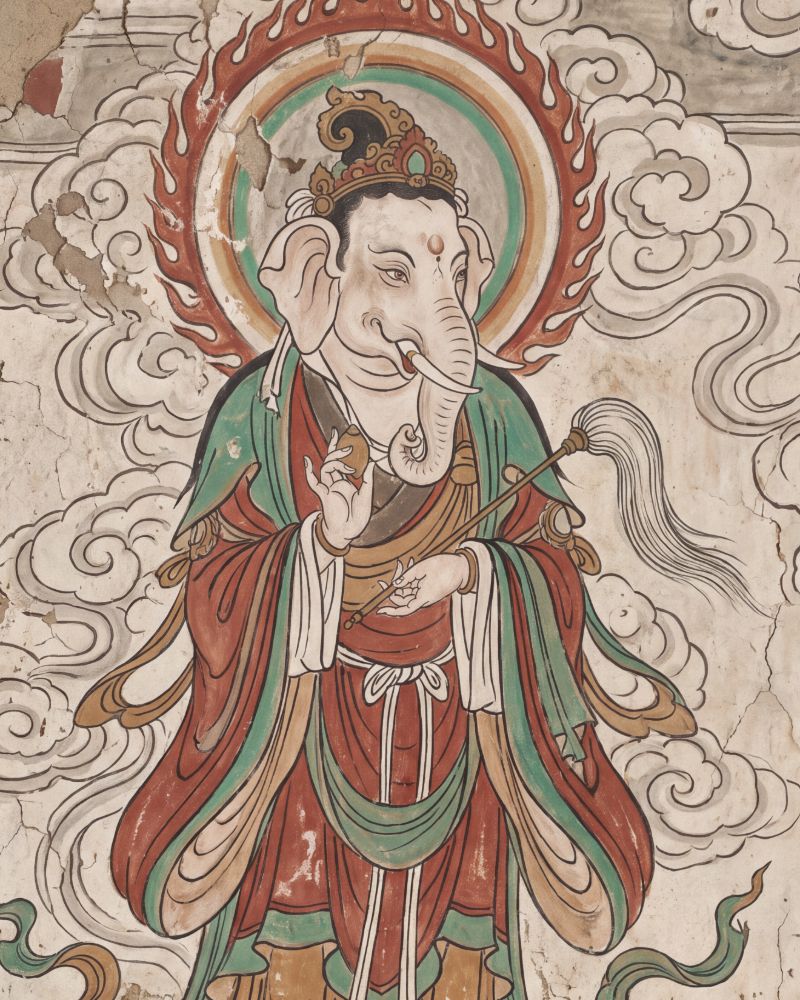
That is what the painting at the top of this page is about. Indra, king of the gods, is face down on the floor. Ganesha is on the throne.
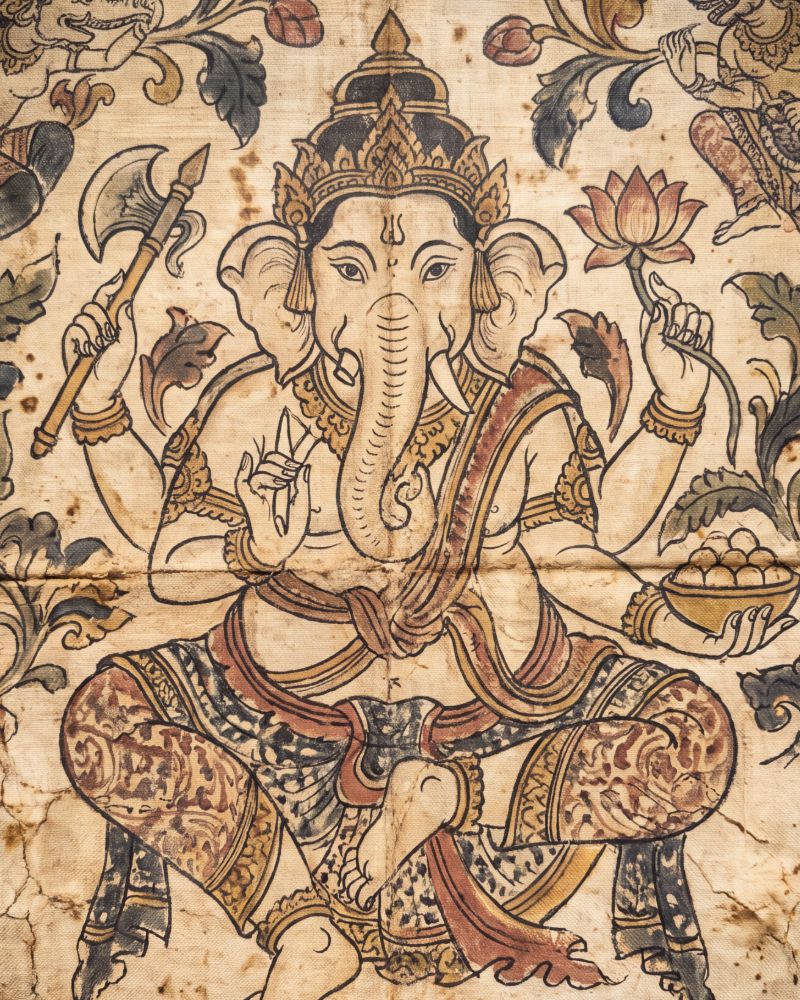
A Kolkata lithograph of the early 1880s catches the same idea from another angle. He is sitting with the pen already in his hand, loose leaves in front of him, and not a word written yet.
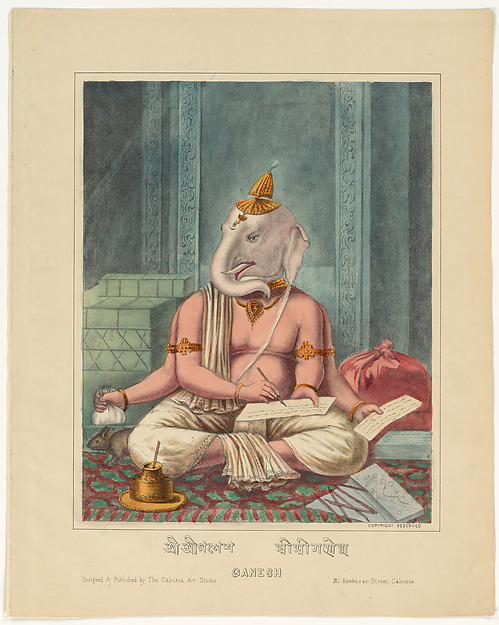
A speciality is a bigger place in one room. Going first is a smaller place in every room. India kept the second.
Choosing Ganesha Wall Art for Your Home
That is the one you are buying, whichever form you choose: the god who goes first. What changes is how he is shown — and the forms in this article are genuinely not interchangeable.
A seated Ganesha reads as settled. It is the posture of the Kolkata lithograph above: still, working, not going anywhere. It suits a room people sit in — a living room wall, a study, the wall behind a desk.
A standing Ganesha reads as arrival. The seventh-century sandstone figure further up this page stands, and so does much of the Southeast Asian sculpture that followed it. Standing forms carry a hallway or an entrance better than a bedroom.
A multi-armed form reads as protection, not decoration. Heramba’s five heads and the Himalayan hook and lasso are protective iconography. If that is what you want on the wall, buy it knowing what it says.
Browse the Lord Ganesha wall art collection for the full range, Madhubani wall art for folk treatments, and traditional wall art for the wider Indian classical range.
If you are building a wall rather than buying one piece, our Indian art gallery wall starter guide covers how many pieces a wall takes before it starts to look crowded.
Where he goes once you own him is a separate question with its own rules. Our vastu guide to paintings for the home covers every wall, and Ganesha painting vastu covers direction, placement and the spots to avoid.
Go and look at the Ganesha already in your house. Is he seated or standing, and is he facing into the room or at the door? Every tradition in this article asked him for something different. Tell us what yours is being asked.
Next in this series: Saraswati, and how she became Benzaiten — one of Japan’s Seven Lucky Gods.
Ganesha Around the World: Common Questions
Why is Ganesha on Indonesian money?
Indonesia’s 1998-series 20,000-rupiah note carried Ganesha alongside Ki Hadjar Dewantara, the figure regarded as the father of Indonesian education, with a Taman Siswa classroom on the reverse. The note was built around an education theme, and Indonesia treats its pre-Islamic Hindu-Buddhist past as national heritage rather than as a foreign religion.
Is Ganesha worshipped in Japan?
Yes, as Kangiten or Shōten, within esoteric Buddhism. The practice is unusual: the image is a concealed icon that is not shown publicly, and worshippers offer daikon radish instead. The two principal temples are Matsuchiyama Shōden in Tokyo and Hōzan-ji on Mount Ikoma near Nara, which Osaka’s merchants have visited since the seventeenth century.
Why is Ganesha on a Thai government seal?
Thailand’s Fine Arts Department uses a seal of Ganesha as its emblem, because he is regarded as the patron of the arts. The department is the arm of the Ministry of Culture responsible for national heritage, and has been since 1912. Thai artists and performers also honour him before starting new work, in the teacher-homage rite called wai khru.
Where is the oldest Ganesha statue outside India?
The earliest securely dated examples outside India are seventh-century sculptures from southern Cambodia, with Cham carvings from present-day Vietnam in the same period. The marble Ganesha from Gardez in Afghanistan is now dated to the eighth century, so it is later than the Southeast Asian carvings rather than earlier.
What does a five-headed Ganesha mean?
That is Heramba Ganapati — five elephant heads, ten arms and a lion as his mount, rather than the usual single head and mouse. The form originates in India but appears most often in Nepal, where Newar Buddhist and Hindu traditions both treat five-faced icons as especially protective.