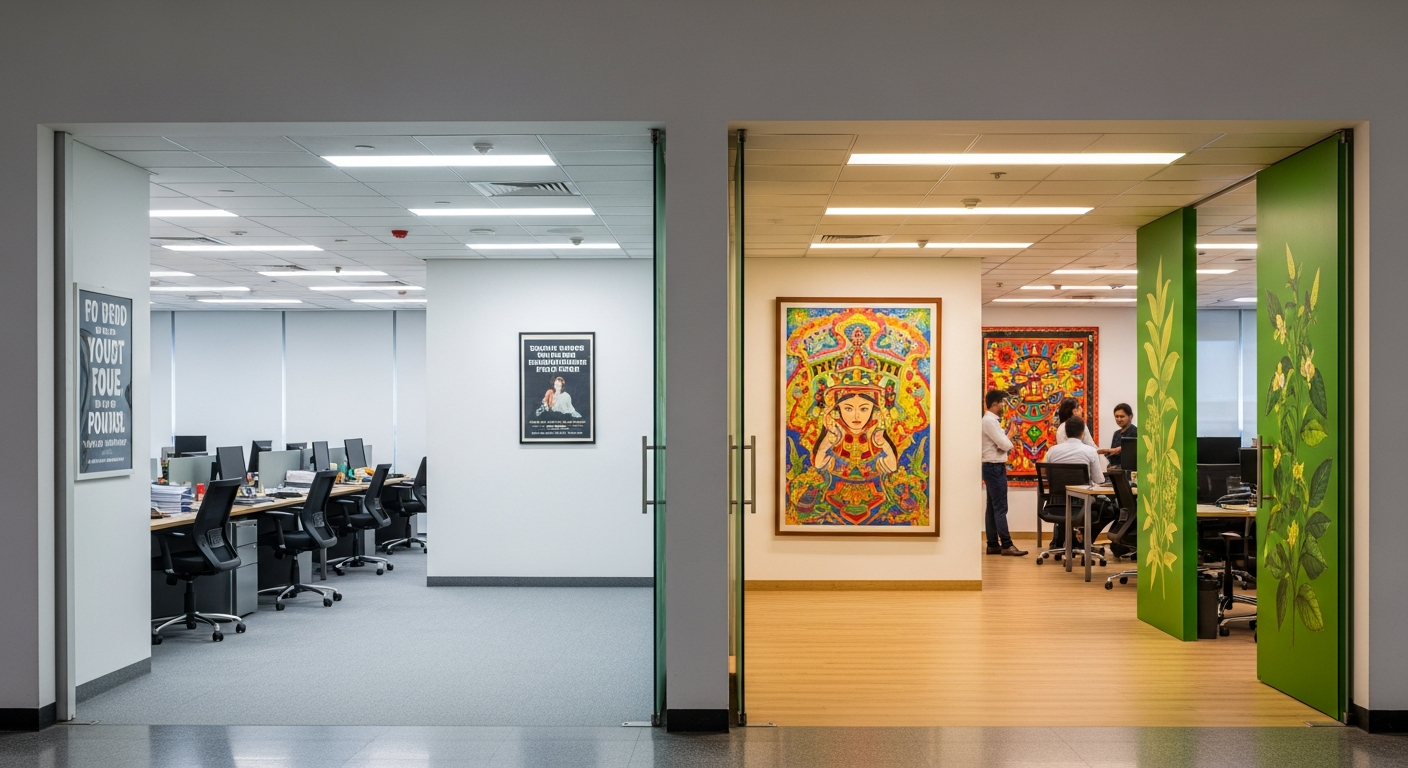
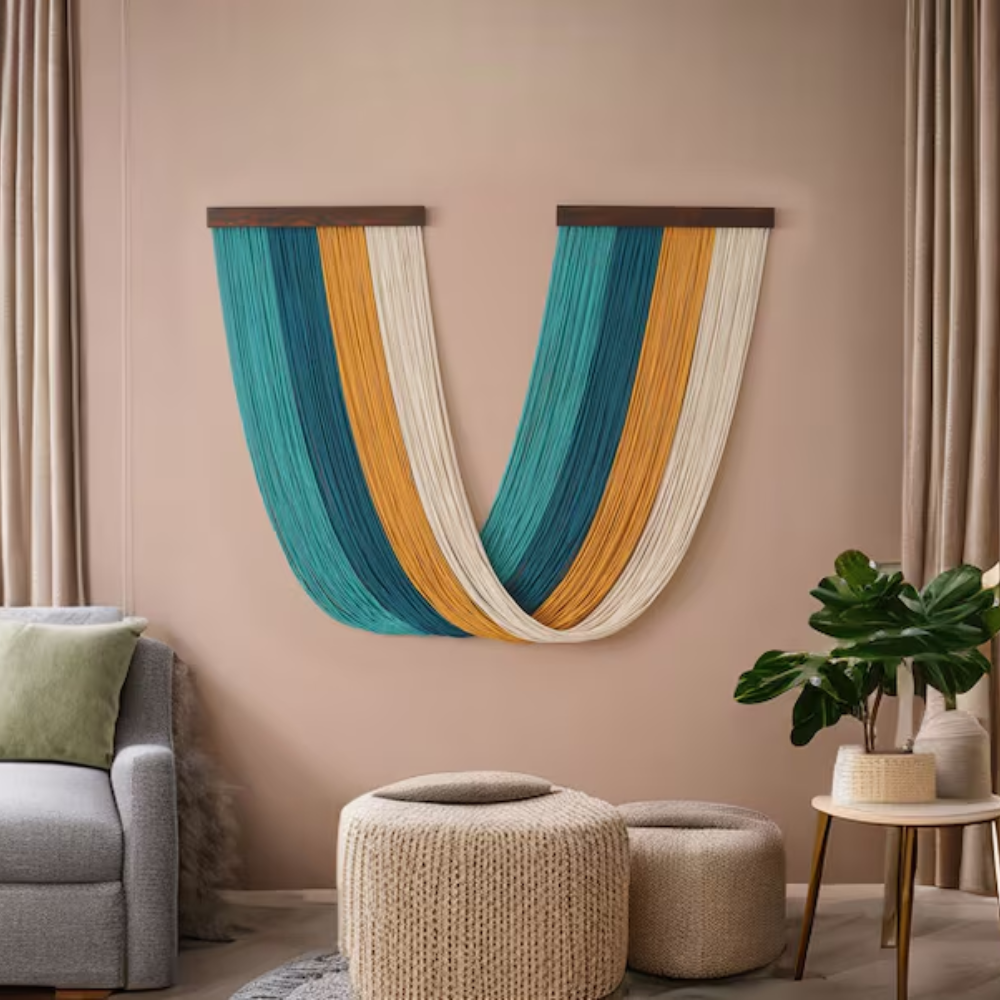
Most Indian flats are built from hard surfaces: vitrified tile, plastered concrete, aluminium windows, glass-topped tables. A macramé hanging is the opposite: soft, matte and full of small shadows, so one piece can make a room feel lived-in without adding clutter.
This guide covers where to hang one, what size to buy, what to pair it with, and how to keep cotton looking good through dust season and the monsoon. If you already know what you want, browse our full range of macramé wall hangings: at the time of writing, half-moons and rounds start from ₹1,849 (most from ₹2,249), single ovals from ₹3,249, and three-oval sets and wide fringes from ₹4,999 to ₹8,749 — each price is for the smallest size.
First, know what you are buying: knotted, fringed or woven
Shops use the word “macramé” for three different crafts:
- Knotted macramé, the technique the word really means: cords mounted on a dowel or ring with lark’s head knots, then worked in square knots and half hitches.
- Fringe hangings: mostly cord falling from a bar, board or cane frame, like the half-moon and arch pieces.
- Woven or framed yarn art: yarn wrapped or woven across a frame, flatter and more graphic, closer to a painting.
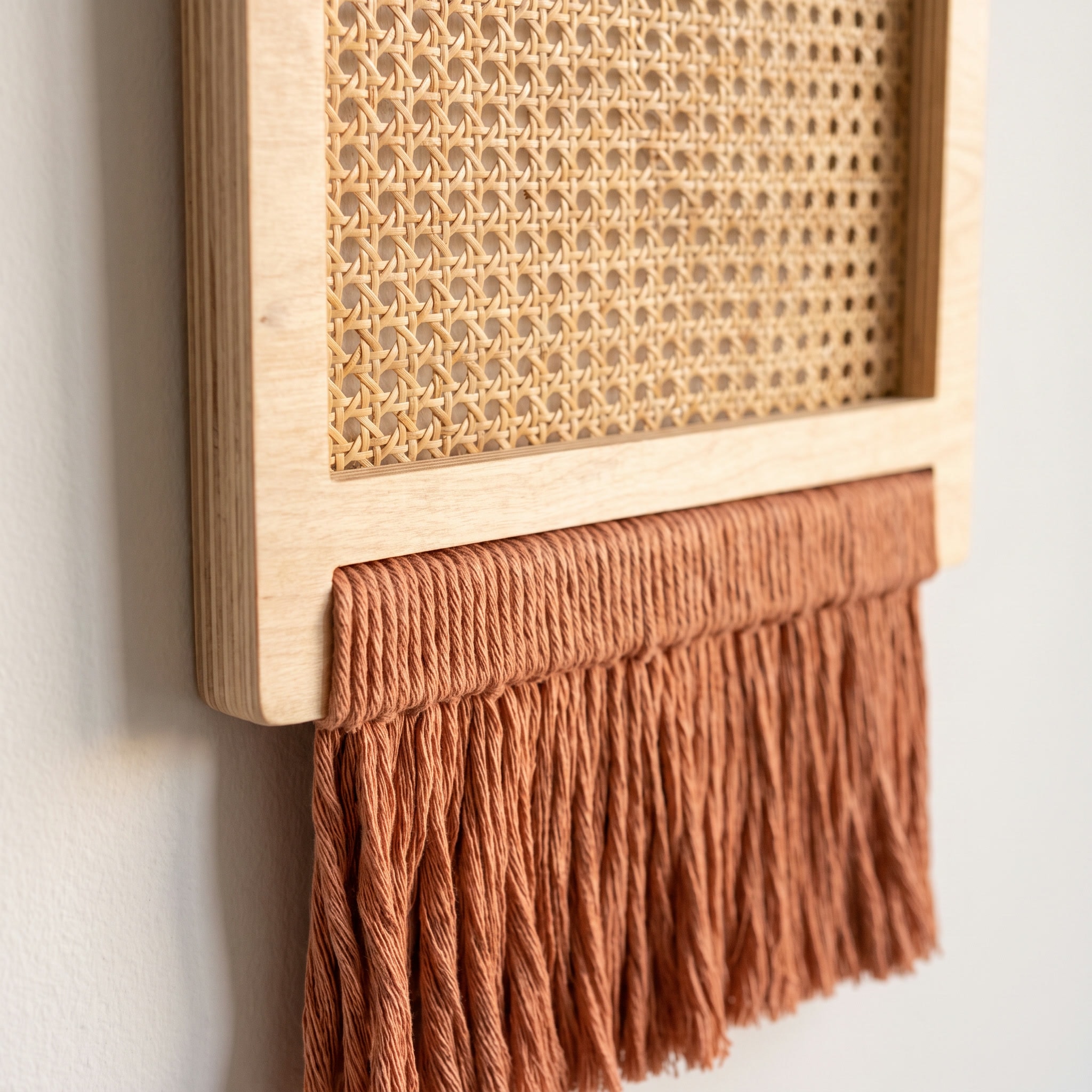 Close up: woven cane in a plywood frame, with a straight cotton fringe below.
Our range covers all three. Each piece is handmade by village artisans, so expect small differences from the photo. Product pages list the build (cotton yarn on an engineered wood board, HDMR, or on wood), with hooks on the back so it arrives ready to hang.
10 macramé wall hanging ideas, room by room
1. Living room: one wide statement over the sofa
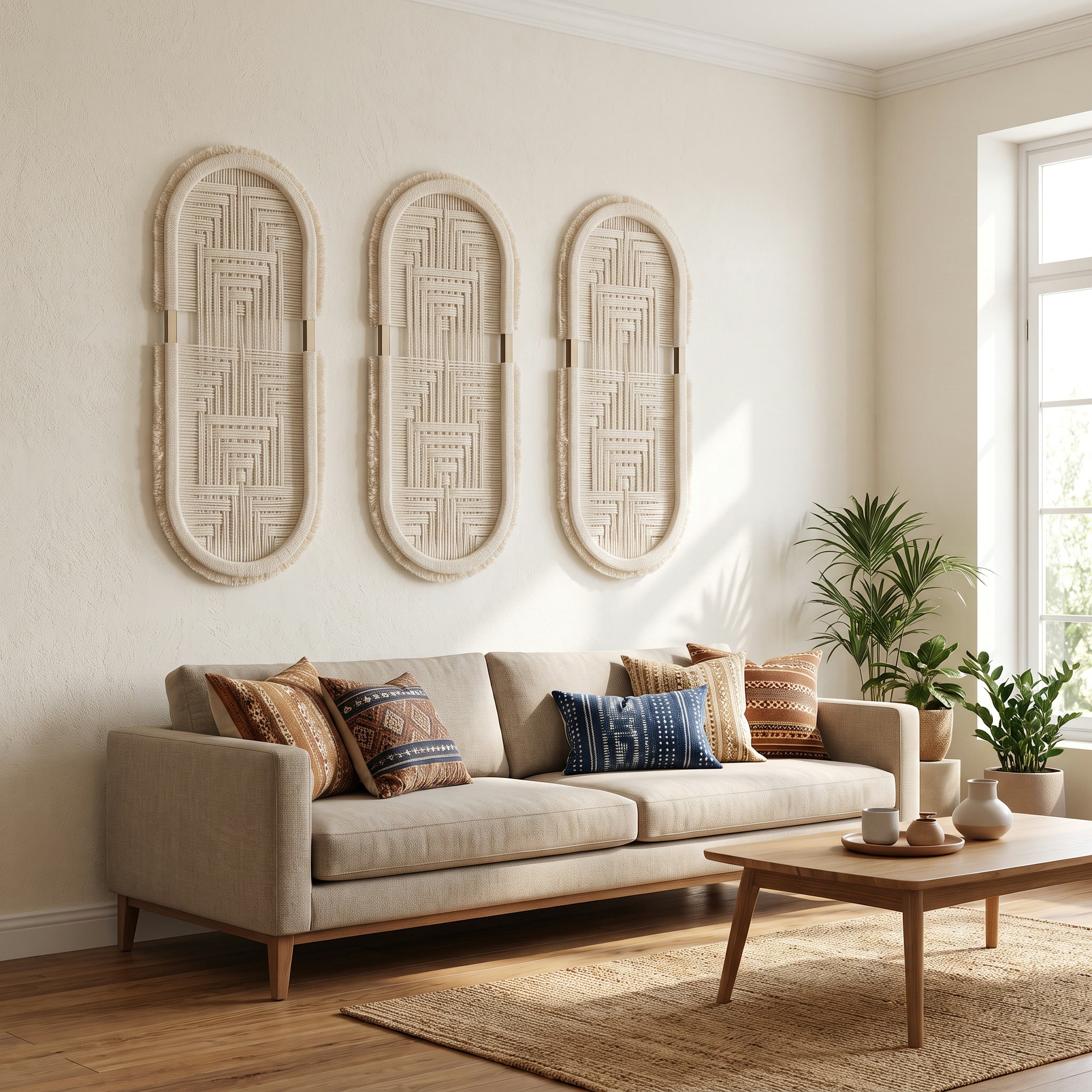 Three natural-cotton ovals spaced as one unit fill the sofa wall and let the cushions carry the colour.
A single small round looks lost on a long sofa wall. Go wide, to about two-thirds of the sofa’s width: three ovals spaced as one unit, or one bar-hung fringe. Natural off-white cord, as here, keeps a busy room calm; dyed cord makes the hanging the accent, so repeat one colour from the cushions or rug. Conservation guidance for museum textiles notes that UV fades many dyes and yellows fibres, so on a bright wall dyed cord softens while natural cord warms in tone.
2. Living room: a colour block above a low shelf or sideboard
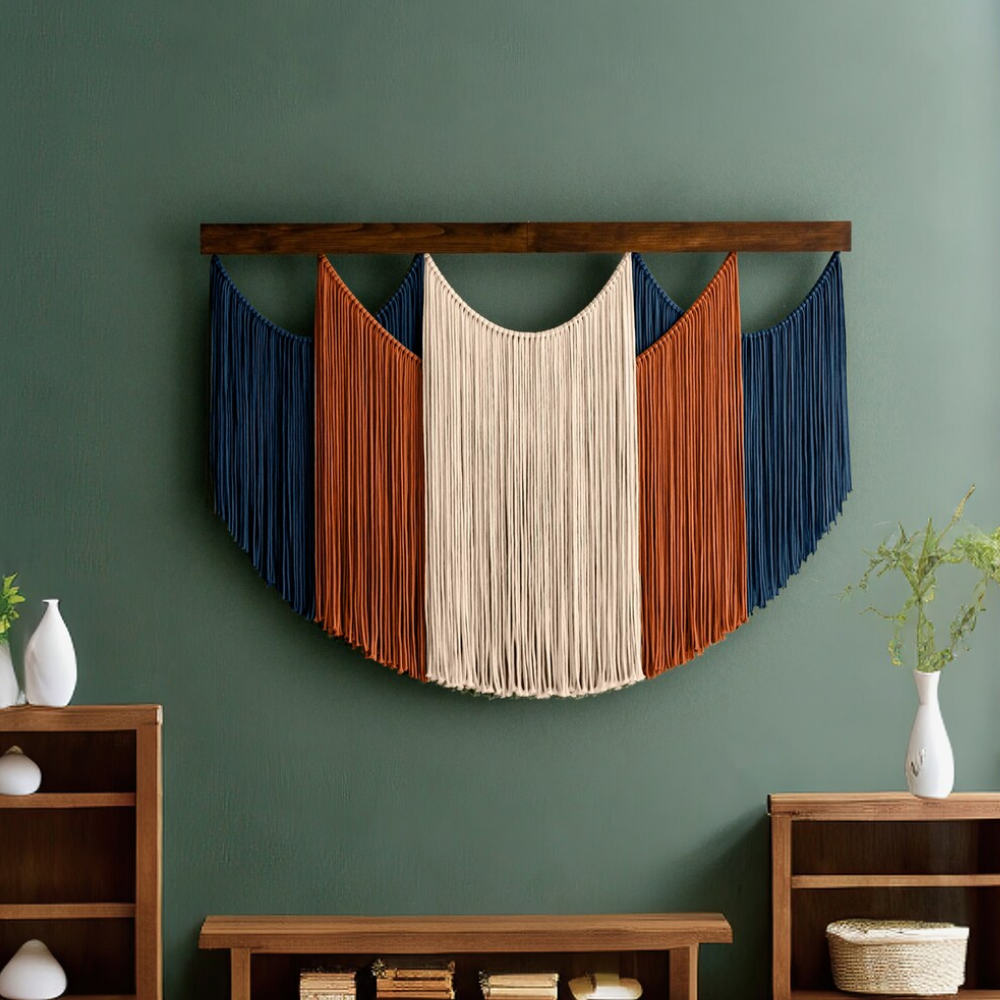 A bar-hung scalloped fringe fills the wall above low wooden furniture.
A wide fringe on a wooden bar fills the empty wall above low furniture without the weight of a framed print, and deep green, teal or terracotta walls make cream and rust cords glow.
More shapes and colours in the full macramé wall hanging collection.
3. Bedroom: above the bed
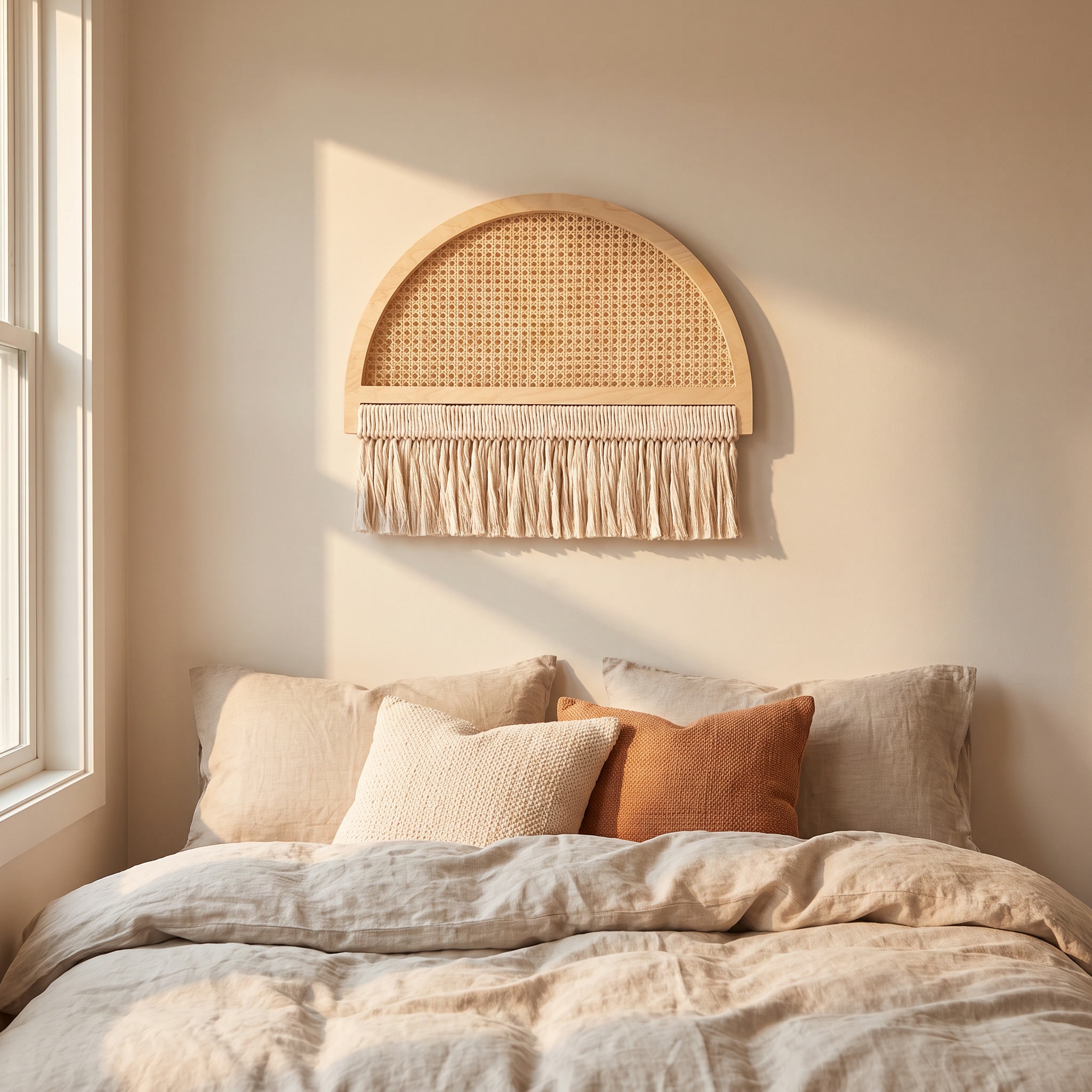 A cane half-moon with straight cream fringe, hung well clear of the pillows.
The classic spot, with no glass over a sleeping head; the piece above is our Semi Circle hanging with straight fringe. The 20–25 cm gap that works above a sofa is not enough here: sit up against the headboard, mark the wall a hand-span above your head, and keep the lowest fringe tip above that mark. With a tall headboard, that usual gap is enough. A bed 60 inches wide wants about 40 inches of hanging (two-thirds of its width), so choose a wide bar-hung fringe or three half-moons in a row.
4. Bedroom: the slim wall beside the bed or window
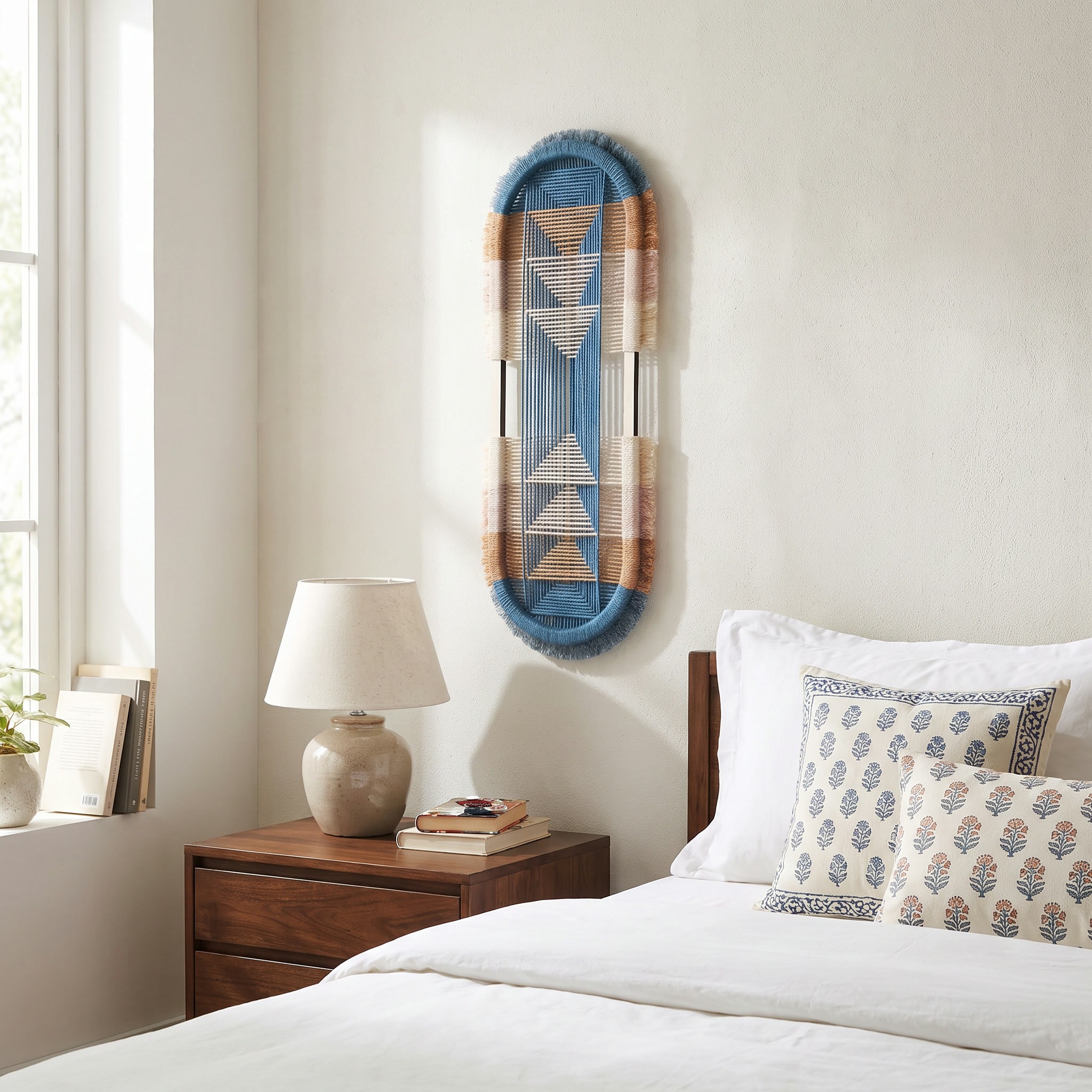 A single tall oval fits the awkward strip between bed and window.
The strip between wardrobe and window, or on a column, is made for a tall oval. Line its top up with the window frame, or centre it at eye level.
5. Entrance: an arch over the console or shoe cabinet
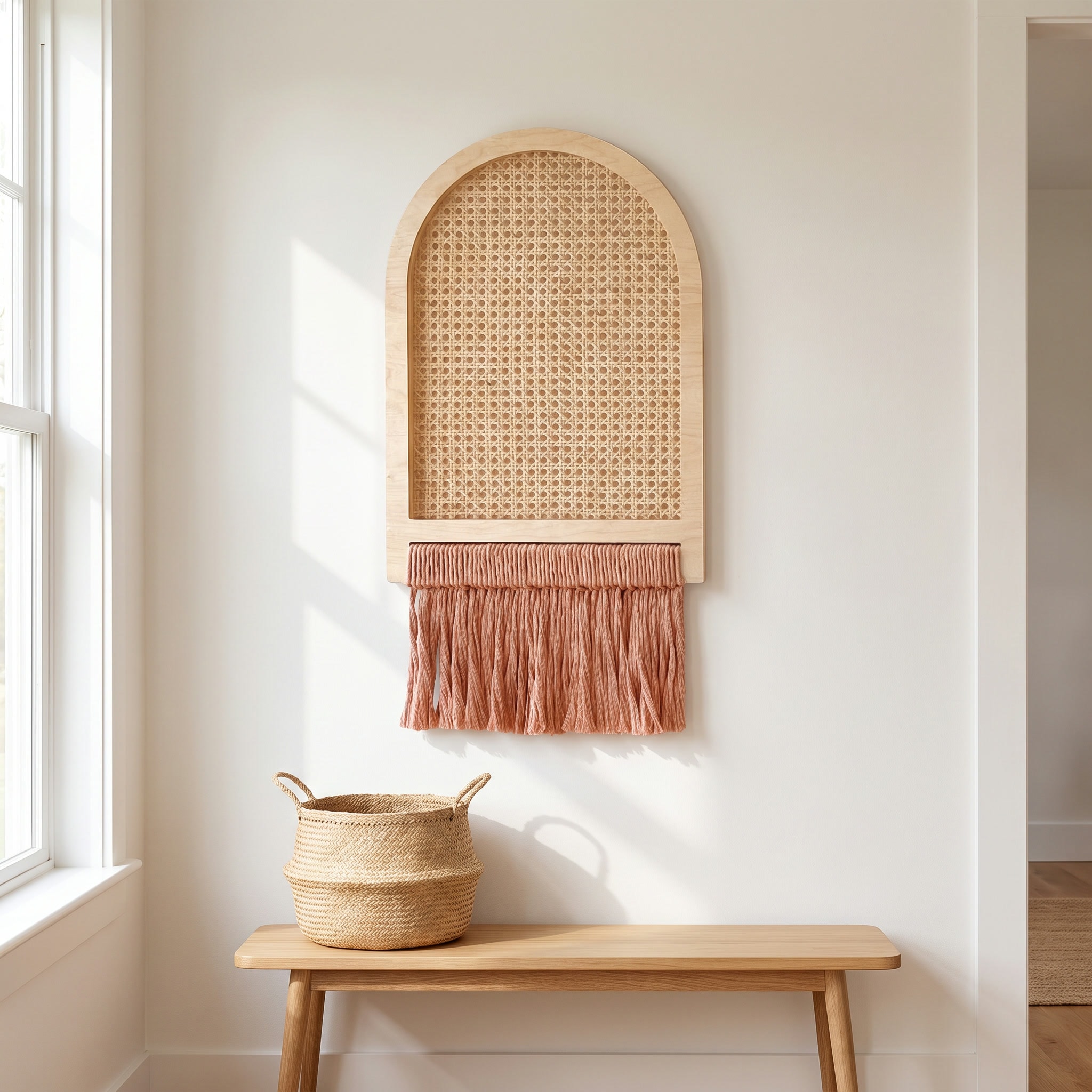 An arch above the console echoes the doorway and gives guests something to see besides shoes.
An arch above the shoe cabinet repeats the shape of the doorway. Keep it out of the door’s swing and away from wet umbrellas.
6. Reading corner: a framed yarn panel above the chair
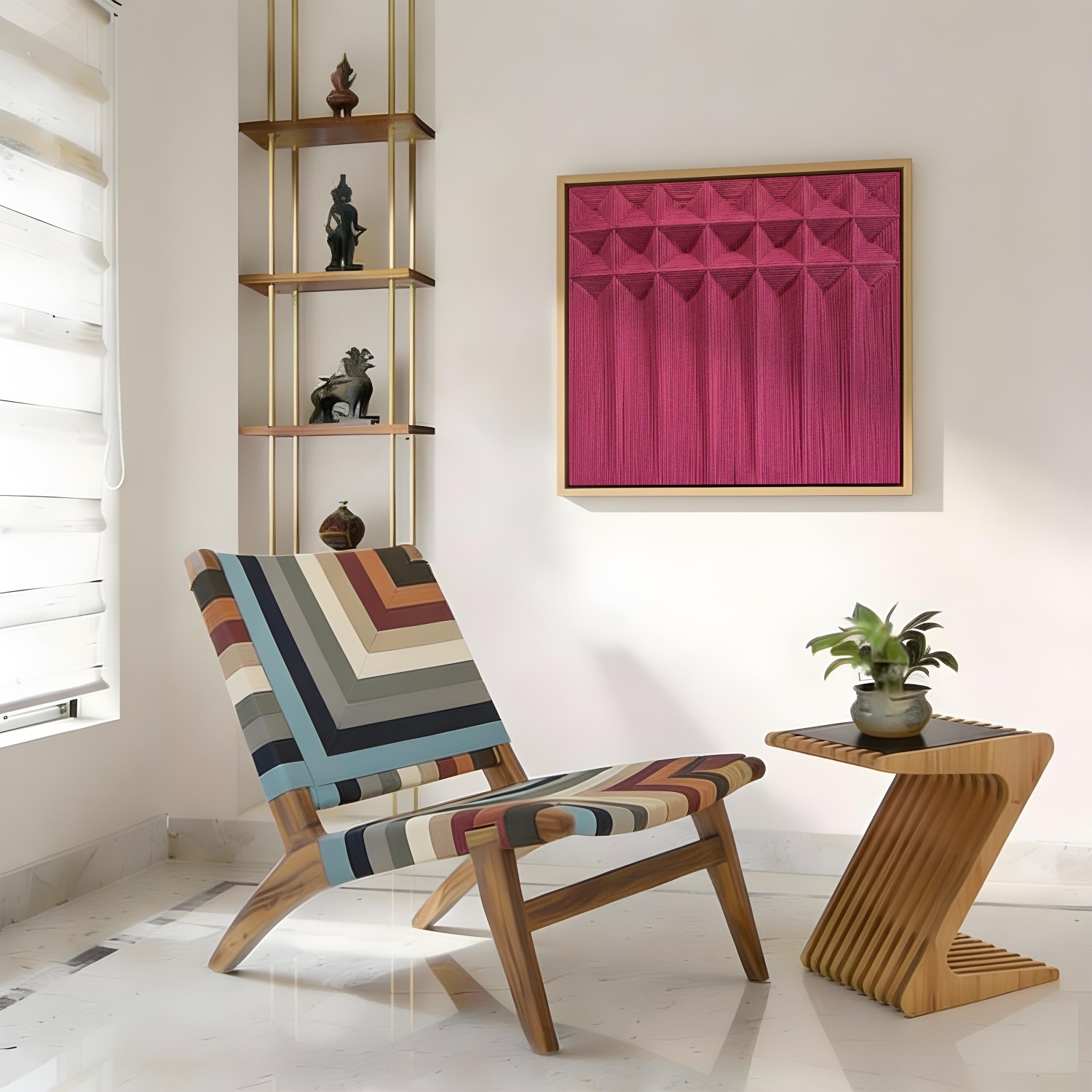 Framed yarn art keeps crisp edges and reads closer to a painting than a fringe does.
A framed panel like this Pyramid and Pleat design gives a chair-and-side-table corner a focal point, with no loose fringe to tangle or gather dust.
7. Covered balcony: a dry-season spot
A covered sit-out can take a framed yarn panel in the dry months, on the back wall, out of reach of rain and direct afternoon sun. Bring it indoors before the monsoon: balcony air can stay humid for weeks even where no rain lands, the condition cotton handles worst. In a coastal city where the air stays muggy beyond the monsoon, keep it indoors all year. For pairing art with greenery, see our biophilic wall art guide, and keep pots and watering cans clear of the cotton.
8. Work-from-home wall: texture behind the video call
A knotted piece behind the desk adds depth on camera and, with no glass, reflects no screen or ring light. An 18-inch Half Circle Knot hanging in one colour sits behind your shoulder and reads as texture, not pattern.
9. Kids’ room: soft colour, hung high
A Cloud and Fringe hanging or a Rainbow Arc round suits a child’s room. Hang it above the reach of small hands. Never hang a long-fringed piece over or beside a cot.
10. Rented flat: fixings that suit the piece
Hang each piece as its product page describes, using every hook on the back, with fixings chosen for its weight and backing. Weigh it on a kitchen scale first: board-backed ovals and half-moons, bar-hung pieces and framed panels carry wood as well as cotton. If your lease bans drilling, our renters’ decoration guide explains adhesive hook ratings (usually per strip) and warns that chalky builder-grade paint may not hold tape. Skip adhesive on walls that feel damp in the monsoon, and above a bed, use a screw and wall plug.
The size rule that prevents most mistakes
Our gallery-wall rule applies: the piece, or the group, should be about two-thirds the width of the furniture below it. A 72-inch sofa wants about 48 inches; three 12.5-inch ovals with 5-inch gaps come to 47.
- Count the fringe. Long tails add drop; check in the product photos where the measurement stops.
- Get the height right. On an open wall, centre the piece about 145–152 cm from the floor. Above a sofa or sideboard, leave 20–25 cm to the lowest fringe tip. Beds need more (idea 3).
- Do the paper test. Tape newspaper cut to size on the wall for a day. If bare wall still dominates, size up.
| Where it goes | Shape that works | Sizes to look at in our range |
|---|---|---|
| Above a three-seater sofa | Three ovals, or one wide bar-hung fringe | Ovals at 12.5 × 36 in; scalloped fringe 44–52 in wide |
| Above a queen bed | A wide bar-hung fringe, or three half-moons | Scalloped fringe 36–44 in, or three 12-inch half-moons |
| Narrow strip beside a bed, window or pillar | Tall and slim | A single oval, 8.5 × 24 to 12.5 × 36 in |
| Over an entrance console or shoe cabinet | An arch or round, narrower than the unit | Arches and rounds at 18–23 in |
| Reading corner (or a covered balcony in the dry months) | Framed yarn art | 18 × 18 to 24 × 24 in |
| A gift | Small and neutral | Rounds at 12–15 in, or a single oval |
Care in Indian conditions: dust, sun and the monsoon
Dust and marks
Every few weeks, shake cord and fringe pieces gently outdoors and go over them with a soft brush. Framed and board-backed pieces stay on the wall: brush them lightly top to bottom, or use a hair dryer on cool to clear the ridges. Dab marks with a white cloth, mild detergent and cold water. On coloured yarn, test a hidden spot first, since strong dyes can bleed into neighbouring cream; blot, don’t rub, and dry the patch quickly under a fan so it leaves no water ring. Never submerge a piece attached to wood or board, or machine-wash it. Steam, or iron through a tea towel, takes kinks out of fringe; keep heat off glued areas. The core steps follow our product care notes.
Sun
The Canadian Conservation Institute (Government of Canada) notes that light fades colours and weakens fibres, that the damage is cumulative and irreversible, and that UV in daylight is a major cause of yellowing. That is museum guidance, but the physics holds at home: pick a wall out of direct sun, or draw the curtains through the harshest hours.
Monsoon humidity and mould
The same institute says relative humidity of 65–100%, warm temperatures and poor air circulation promote mould on textiles, cotton being particularly vulnerable, and that mould is unlikely below 60% with good air movement. You cannot cool a July afternoon, but you can control the other two:
- Hang on an internal wall, not an exterior wall that seeps in heavy rain.
- Keep a fan running, and use a dehumidifier or your AC’s dry mode on muggy days; a digital hygrometer shows the actual humidity.
- Give cane panels and wooden frames the same dry air, and wipe them with a dry cloth, never a wet one.
- Lift the piece once or twice in the monsoon to check the wall behind.
- If the flat will be shut for a week or more in the rains, store clean, dry pieces in a cotton bag or old pillowcase, not plastic.
- Skip bathrooms and kitchens.
If spots appear, treat it as a health matter: the institute calls mould a serious health concern, says people with asthma or allergies should stay away from it, and names an N95 respirator, disposable gloves and goggles as the minimum for a small patch. It cleans by close vacuuming outdoors on a clear, dry day, away from other people, and strongly recommends a HEPA-filtered vacuum so spores are not blown about. Without one, don’t improvise indoors; a piece with more than a few spots or a lingering musty smell is better replaced.
Pairing macramé with Indian décor
- Natural cotton with Warli. Off-white knots beside Warli art share one quiet palette.
- Colourful fringe with block prints and dhurries. Repeat one colour from the cushions or rug in the cords.
- Dense folk art with breathing room. Beside a Madhubani painting, let the macramé be the calm piece, a hand-span away.
- Cane, brass and sheesham. Cane-panel half-moons belong with wooden furniture and brass lamps.
- Plants. A trailing pothos beside a hanging looks lovely; keep watering off the cord.
The craft itself is far older than the boho revival. The V&A in London holds a macramé border knotted from linen thread, possibly made in Italy or Spain around 1600, and a macramé window hanging made in Britain in 1979.
A gift that fits almost any wall
For a housewarming, neutral cotton suits a wall you have not seen. Choose small, like a 12–15 inch round or a single oval; a custom name piece makes it personal. See also our home décor gifts and griha pravesh gift guides.
Measure first, then shop
Take your measurements to our macrame wall hanging collection and shortlist by size first, colour second. Delivery is free in India, and cash on delivery is available.
Frequently Asked Questions
What size macramé wall hanging should I buy for above a sofa?
About two-thirds of the sofa’s width. For a 72-inch sofa that is roughly 48 inches: one wide bar-hung fringe, or three 12.5-inch ovals spaced 5 inches apart, with 20–25 cm between the sofa back and the lowest fringe tip.
Where should I hang a macramé wall hanging in a small 2BHK?
Pick one or two spots and size them properly. Above the bed and over the entrance cabinet give the most effect for the least wall; a slim oval suits the narrow strips beside windows and wardrobes. Browse macramé wall hangings by size.
Is macramé suitable for a rented flat?
Yes, with the right fixings. Weigh the piece, choose adhesive hooks whose combined rating comfortably clears that weight (ratings are usually per strip), use every hook on its back, and avoid adhesive on damp or chalky walls.
How do I clean a macramé wall hanging?
Shake cord pieces outdoors and brush framed ones on the wall. Spot-clean with a white cloth, mild detergent and cold water, testing dyed yarn first. Never soak or machine-wash it.
Will macramé get mouldy during the monsoon?
It can if it stays damp. Conservation guidance links mould on cotton to humidity above about 65%, warmth and still air: hang it on a dry internal wall, keep air moving, and check behind it in the rains.
Should I choose cotton or jute macramé?
Cotton is softer and smoother; jute is rougher, more rustic and naturally brown. Our pieces are made in cotton yarn, in a wide spread of colours.
Can macramé go on a balcony?
Only on a covered balcony, on a wall that rain and direct afternoon sun cannot reach, and only in the dry months. Bring it indoors for the monsoon, when balcony air stays damp enough for mould even without rain. A framed yarn panel is the easiest type to move.