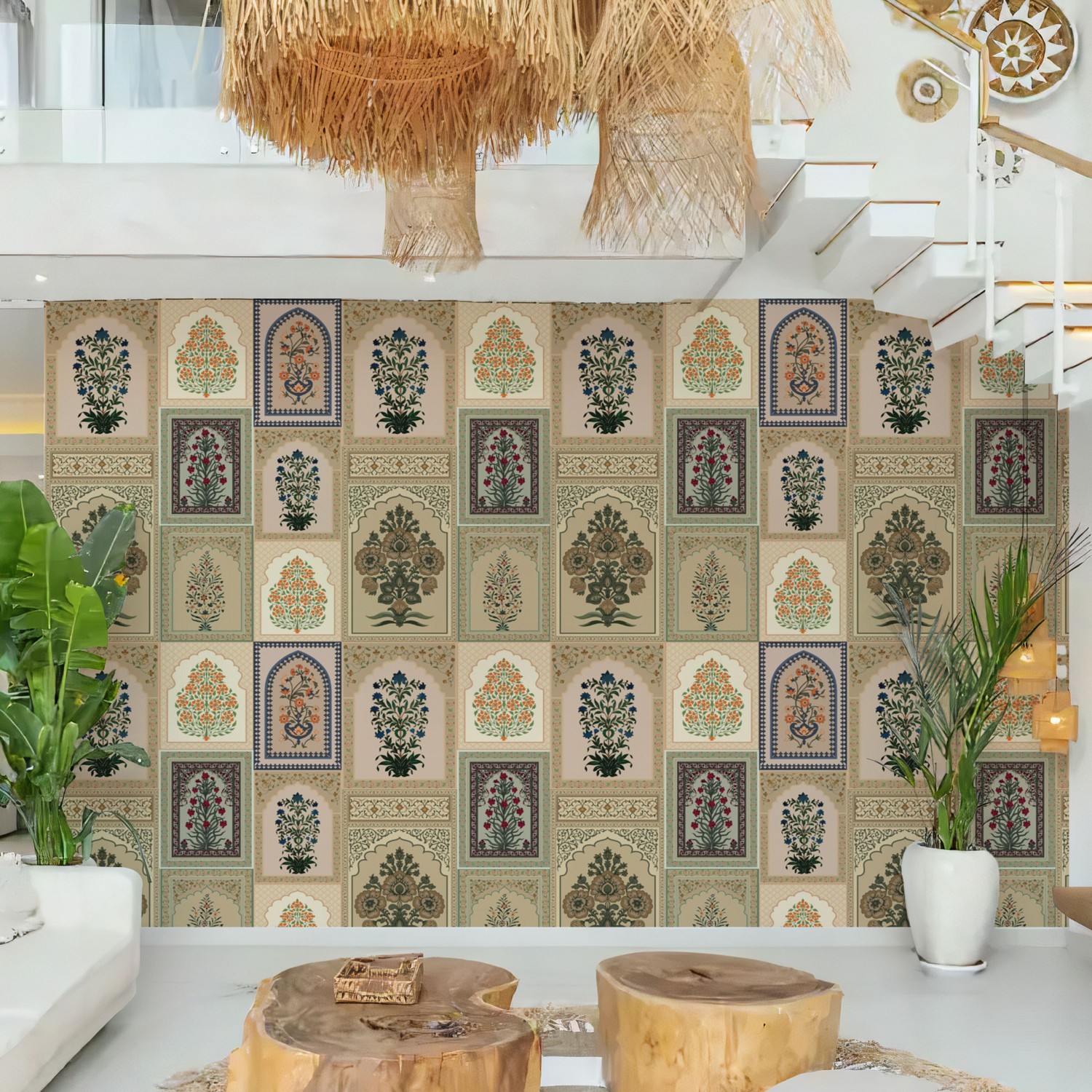
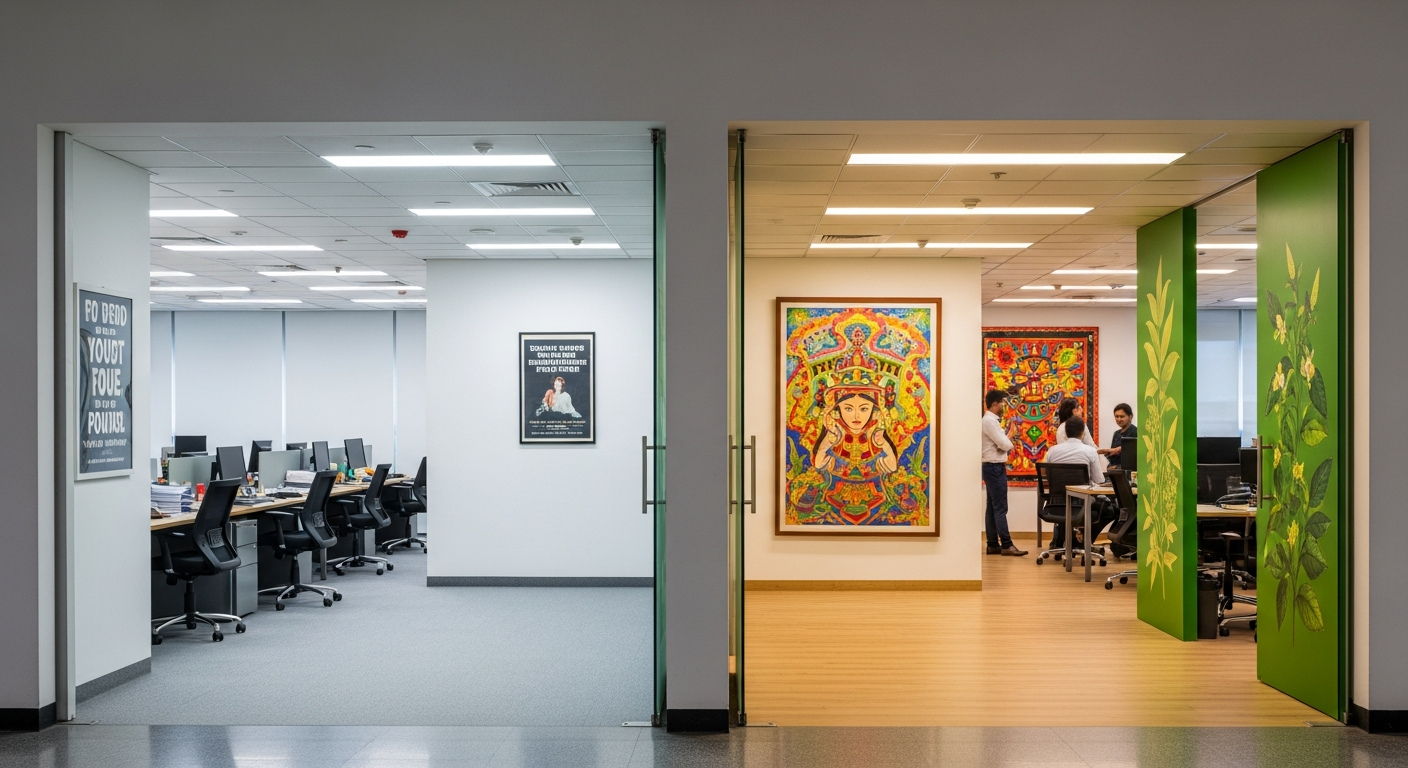
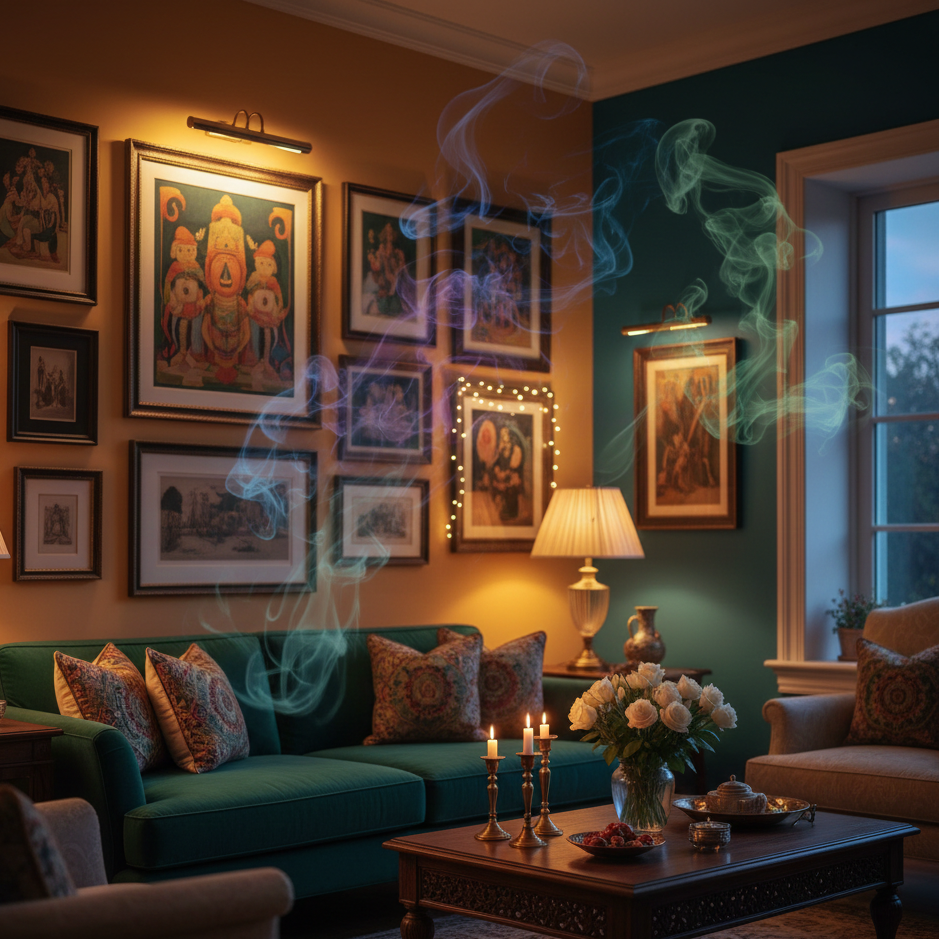
Diwali wall decoration in most Indian homes stops at the door. Rangoli goes on the floor, diyas line the windowsill, a toran hangs over the frame — and every wall inside the house, the single largest surface in every room, looks exactly as it did in September. The fifteen ideas below fix that zone by zone: the entrance wall guests judge first, the pooja corner that carries real weight this time of year, the sofa wall people sit under, and the corridors nobody thinks about until the walls still look bare.
Why Most Diwali Wall Decoration Stops Below Eye Level
Every Diwali checklist follows the same geography. Rangoli sits on the floor by the entrance. Diyas line the window ledges and balcony edge. Toran hangs at the door lintel, roughly six feet up. Fairy lights wrap the grill or run along a railing. All of it lives between the floor and eye level — none of it claims the wall.
That’s not a small gap. A living room wall in a typical Indian flat runs 9 to 10 feet wide and close to 9 feet tall — well over 80 square feet that Diwali decorating never touches, year after year. Fixing it just means choosing one or two pieces of wall art for the walls people actually look at this season, sized the way the rest of the house already is.
Start at the Entrance: The Wall Your Guests Judge First
Most Diwali hosting compresses into a handful of days around the puja itself, and the entrance wall is the one surface every visitor sees while still taking off their shoes. It earns more attention per rupee spent than almost anywhere else in the house.
1. A Single Statement Piece Above the Console
Most Indian foyer walls run 3.5 to 4 feet wide above the shoe cabinet or console — narrower than people plan for. A single 24x36-inch canvas leaves 6 to 9 inches of clearance on either side, which reads as deliberate instead of squeezed. Skip anything wider than the console; it starts eating into the doorframe.
2. Flank the Door with a Vertical Pair
Builder flats often leave 10- to 14-inch strips of bare wall on either side of the main door — too narrow for a horizontal piece but right for a matched vertical pair. Two tall, narrow prints in the same frame finish turn a gap that usually holds nothing into a frame for the door itself.
3. A Circular Piece to Break the Rectangles
An entrance wall is already a stack of rectangles: the door, the switchboard, the shoe rack, the mirror. A round piece breaks that pattern without fighting it. Our circular wall art range runs to nearly 800 designs, so there’s real choice in size and subject.
4. Layer Art Behind the Toran, Not Instead of It
Wall art and a traditional toran aren’t competing for the same six inches of door lintel — one sits at the threshold, the other on the wall beside or above it. Hang both. A framed piece a foot or two from the door lets the toran do its job while the wall stops sitting empty the rest of the year.
The Pooja Corner: The One Wall That Should Not Be an Afterthought
Diwali is Lakshmi Puja at its center, and the wall behind the mandir carries real weight this week — it’s where the puja happens, not just where decoration goes. Treat it with more care than a swastik sticker bought at the last minute.
5. A Lakshmi or Ganesha Piece Behind the Mandir
Size the piece to sit above the mandir, not crowd it — leave 4 to 6 inches of clear wall between the frame and the shrine. Our Lakshmi range is genuinely small, so treat it as one specific pick, not something to browse for an hour. Ganesha is the deeper option, with far more choice across styles and sizes, and pairs naturally alongside a Lakshmi piece.
6. Om, Swastik and Symbol Art for a Narrow Pooja Wall
Most flats give the pooja corner just 1.5 to 2 feet of usable wall — too tight for a large painting. A single Om or swastik piece under 18 inches wide, or a small vertical trio no larger than 10x14 inches each, fits that strip without crowding it. This is genuinely a small range, so pick early.
7. Keep the Wall Uncluttered: What Not to Hang Here
A crowded gallery wall behind the mandir competes with the puja instead of supporting it — too many frames, clashing subjects, or a mix of deities and abstract art reads as decoration for its own sake. One or two pieces, in a consistent frame finish, respect that this wall has a job beyond looking festive.
The Living Room Wall: Where Guests Actually Sit
The sofa wall is the highest-traffic surface in the house during Diwali week and the one people photograph without meaning to — the backdrop to every conversation, every plate of mithai, every group photo before guests leave.
8. The Set of Three Above the Sofa
Aim for roughly two-thirds of your sofa’s width, with the frames’ bottom edge 8 to 10 inches above the backrest. For a standard 6-foot three-seater, that’s about 48 inches — one large 40x30 canvas, or a set of three 16x20-inch pieces spaced 2 to 3 inches apart. A matched set solves a bare sofa wall in one order.
9. Warm Metallics That Catch Diya Light
Gold, brass and copper tones behave differently under diya and warm LED light than under daylight — a matte gold frame that looks understated by afternoon picks up a real glow once the lamps are lit. It’s one of the few choices that’s specifically better for this festival than for the rest of the year.
10. Build a Gallery Wall You Can Keep After Diwali
A gallery wall bought only for Diwali is a wall you’ll be redoing in February. Build it around subjects and a frame palette that work year-round, and treat the festival as the reason you finally started rather than the reason it exists. Our gallery wall starter guide covers spacing and frame-mixing in more depth.
11. Peacocks, Lotus and Motifs That Read as Festive Without Being Literal
A peacock, a lotus in bloom, or a warm abstract in gold and maroon reads as festive without announcing “Diwali” the way a diya-shaped canvas or “Shubh Deepavali” typography does. That matters because the second kind has to come down once the festival’s over; the first kind doesn’t.
12. Cushions and Wall Colour Working Together
A sofa wall doesn’t work in isolation — the art, the wall colour and the cushions are one composition, not three separate decisions. Pull one accent tone from the artwork into a couple of cushion covers and the wall reads as planned.
The Walls Everyone Forgets
Three surfaces get zero attention every Diwali and stay visible for the entire two weeks the house is full of guests.
13. The Staircase or Passage Wall
Long, narrow circulation walls — 8 to 12 feet isn’t unusual in a duplex or builder-flat corridor — need a different approach than one statement piece. A horizontal row of five to seven small pieces, 8x10 or 10x12 inches, spaced about 3 inches apart, reads correctly from the angle people actually see it: walking past, not standing still.
For narrow walls like this, wall hangings and 3D relief pieces work better than a flat canvas because they hold their shape at an angle:
14. The Balcony and Grill Wall
October in most Indian cities means dust, and an open balcony wall takes the brunt of it during the exact weeks it’s on display for guests. We don’t stock a dedicated outdoor-rated wall art line, so treat anything hung here as temporary — bring it back inside once the season’s dust and any early damp have settled.
15. The Dining Wall for Mithai and Guest Season
The dining wall gets more use during Diwali than any other week of the year, as the house cycles through mithai and guests in twos and threes. A single wide horizontal piece, 36x24 inches or larger, or a two-panel diptych suits its shape better than a tall portrait — it echoes the table instead of fighting it.
If You Cannot Drill: Renting, Fresh Paint or a Fussy Landlord
Adhesive strips or hooks rated for the frame’s weight hold most lightweight canvases without a single nail — check the rating first, and go heavier-rated above A2 size. Leaning a large piece against the wall instead of hanging it skips the weight question entirely. Wall decals are the lightest option of all for fresh paint or a lease that bars holes — they peel off cleanly when the lease, or the festival, ends.
Getting Sizes Right for Indian Walls
Foyer wall above the console: Most Indian entryway walls run 3.5 to 4 feet wide. A single 24x36-inch piece leaves 6 to 9 inches of clearance on each side.
Sofa wall in a builder-flat living room: A standard three-seater runs about 6 feet wide. Aim for 48 to 54 inches of combined art width — one large 40x30 canvas or a set of three 16x20s.
Pooja corner strip: Most flats give the mandir wall just 1.5 to 2 feet of clear space. One piece under 18 inches wide, or a small vertical trio no bigger than 10x14 inches each.
Staircase or passage wall: These run long and narrow, often 8 to 12 feet. A horizontal row of five to seven small pieces, spaced about 3 inches apart, reads better than one oversized canvas.
Dining wall: Behind a six-seater table, a single wide horizontal piece or a diptych works better than a tall portrait — it echoes the table’s shape.
Order Now or Regret It: Diwali Delivery Timing
Lakshmi Puja night moves every year against the Gregorian calendar, since it follows the lunar one. Check this year’s date on a panchang or calendar app before counting backward — don’t reuse a date from a previous year.
Once you have the date, work backward from what actually happens after you order:
Standard-frame wall art: 3 to 5 business days to make and check, plus 3 to 5 business days of standard transit. Order at least 2 weeks out.
Real wood frames or custom sizes: 7 business days of processing, plus transit on top. Give this at least 2.5 to 3 weeks.
Wall sculptures: The slowest category on our catalogue — 15 business days of processing alone, before transit even starts. Order at least a month ahead if a sculpture is the plan.
Cutting it close: If the timeline above is already tight, don’t guess at what can still be done — message us on WhatsApp with your pincode and the piece you want, and we’ll tell you honestly whether it can still arrive in time before you place the order.
If you’re also picking gifts to carry to Diwali get-togethers, our Diwali gift ideas in wall art guide covers pieces sized for giving rather than hanging, with the same order-by timing in mind.
Ready to Order: Sets Worth Starting From
If the sofa wall is still bare, here are current picks sized to work as a set above a three-seater:
Frequently Asked Questions
How can I decorate my wall for Diwali at home?
Work zone by zone. Hang one statement piece above the entrance console first, since that’s the wall guests see within seconds of arriving. Then size a Lakshmi or Ganesha piece for the pooja wall. Finish with a set of three above the sofa — the wall people sit under for the rest of the season.
What can I hang on the wall for Diwali?
Framed wall art, a matched set of two or three, circular pieces, 3D relief or macrame wall hangings, and wall sculptures all work well. Paper toran and marigold garlands belong at the door, not the interior wall — keep those for the entrance and treat the walls inside as a separate decision.
How to decorate a wall for Diwali without drilling?
Use adhesive strips or hooks rated for the frame’s weight, lean a large canvas against the wall instead of hanging it, or choose peel-and-stick wall decals for a lighter, temporary look. Check the weight rating on any adhesive strip before you commit — most are rated for only a few kilograms per pair.
What size wall art should I buy for my living room?
Aim for roughly two-thirds of your sofa’s width, with the bottom edge 8 to 10 inches above the backrest. For a standard 6-foot three-seater, that’s about 48 inches of combined width — a single 40x30 piece, or a set of three 16x20s spaced a few inches apart.
Which wall decoration is good for Diwali as per vastu?
Lakshmi and Ganesha pieces generally suit the northeast or east wall of the pooja corner, and peacock or lotus motifs work well in the living room’s north or east. Direction and placement doctrine deserves more space than fits here — our vastu paintings for home guide covers the room-by-room detail.
How early should I order wall art before Diwali?
Check this year’s Lakshmi Puja date first, since it shifts annually. Standard-frame wall art needs 3 to 5 business days to process plus 3 to 5 for delivery; wood frames, custom sizes and sculptures need 7 to 15 business days of processing alone. Count back at least 2 to 3 weeks for framed art, a full month for sculptures.
Can I use the same decoration after Diwali?
Yes, if you choose subjects that aren’t explicitly Diwali-branded. A lotus, a peacock, a warm abstract, or a Ganesha painting works in November and in July equally well. Save anything diya-shaped or printed with “Shubh Deepavali” for the string lights and paper toran — those are the pieces worth treating as seasonal.
Your Diwali Wall, Sorted
Start at the door, because that’s the wall every guest actually looks at. Give the pooja corner the restraint it deserves — one considered piece beats a cluttered one. Let the sofa wall do the hosting work, and don’t leave the staircase or dining wall as an afterthought; both stay visible for the two weeks the house is full of people.
If vastu placement matters to your decision, our vastu paintings for home guide covers direction and placement room by room. And if you’re starting from a genuinely bare wall, browse the full wall art collection and work backward from there — sized right, none of this has to come down once the festival ends.