

BestOfBharat
Free Shipping across India
What can we help you find?
What can we help you find?
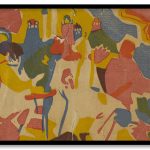
Wassily Kandinsky believed a painting could work the way music does, without describing anything at all. He began with Russian folk colour and Munich landscapes, then dissolved the subject until only line, circle and hue remained. Composition VIII and Yellow-Red-Blue come from that shift. On a wall the effect is bright and structural: strong primaries held in balance, geometry that keeps a modern room from going flat.
Wassily Kandinsky (1866-1944) was born in Moscow and trained as a lawyer before turning to painting at thirty. He co-founded Der Blaue Reiter in Munich, taught at the Bauhaus through the 1920s, and died near Paris. Kandinsky is credited with the first purely abstract paintings in Western art. He wrote about it too: Concerning the Spiritual in Art argues that colour and form carry feeling on their own, the way a chord does. His early work is loose and stormy. The Bauhaus years brought compasses and rulers, circles, grids and floating triangles.
The range runs from the early Munich pictures and the Phalanx exhibition poster to the numbered Compositions. Composition IV, Composition VIII and Composition X are here, with Transverse Line, On White II and Yellow-Red-Blue. Palettes vary widely. Some prints are near-monochrome black on white. Others carry the full primary set against ochre or deep blue.
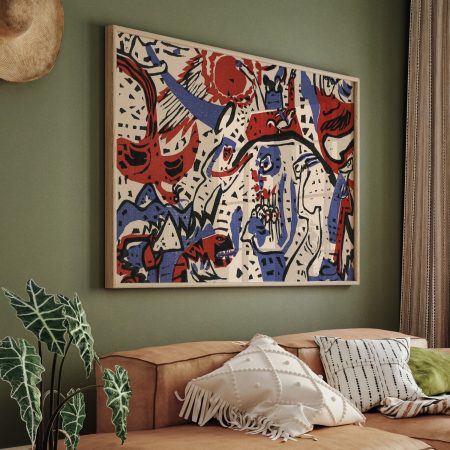
These prints want space around them. A single large Composition over a low sofa gives a neutral living room its focal point. In an office or studio, a pair of the geometric Bauhaus works gives the room a clear order. The strong primaries sit well with pale walls, oak, and grey upholstery. Avoid crowding a Kandinsky with other patterned art. It holds a wall on its own.
Every artwork here is an archival print, hand-framed to order and delivered ready to hang — made in India.

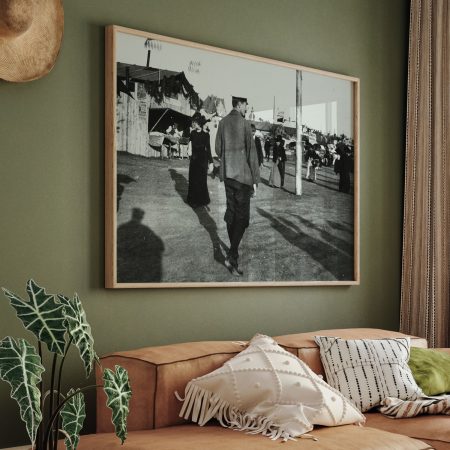
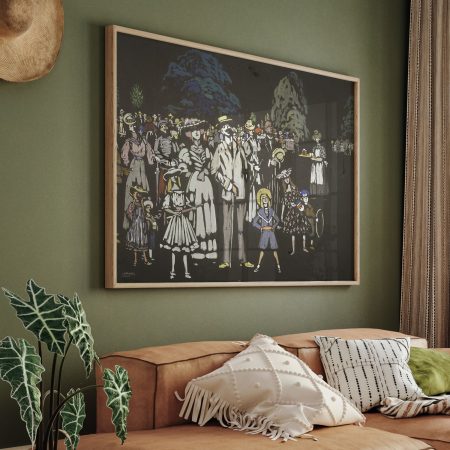
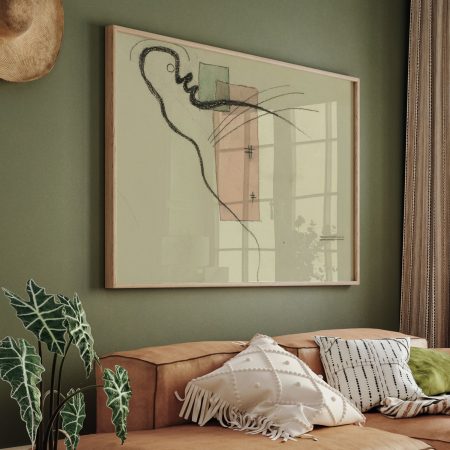

Wall Art
by Wassily Kandinsky


Wall Art
by Wassily Kandinsky


