Free Shipping across India
What can we help you find?

Ludwig Becker was a naturalist and painter who recorded Australian species when few Europeans had seen them. Born in Germany, he settled in Victoria and drew fish, crustaceans, birds and insects with a scientist's care. The plates are precise and softly coloured, with the specimen placed alone on pale ground. Framed, they bring the character of an old museum cabinet to a hall, study or dining room.
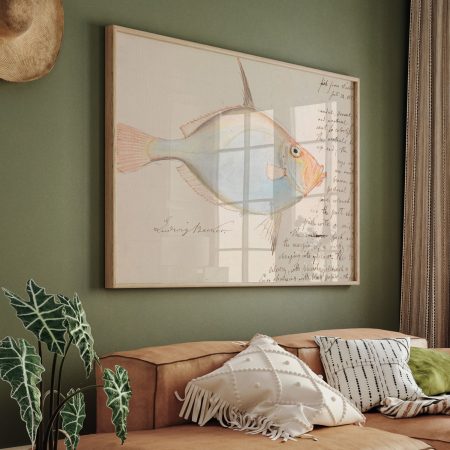


Ludwig Becker (1808-1861) was a German-born artist and naturalist who emigrated to Australia in 1851. He worked first in Tasmania, then in Victoria, painting and describing species for the colony's scientists. In 1860 he joined the Burke and Wills expedition as its artist and naturalist, sketching the interior as the party moved north. He died on that journey in 1861. His watercolours are among the earliest careful records of Australian wildlife.
The range covers his zoological plates: the Weedy Seadragon, the Silver Dory, the Murray spiny crayfish. Each shows a single specimen on plain ground, drawn from observation, in muted brown, grey and sea-green. The style sits between science and drawing, which is why these prints read as handsome rather than clinical. They suit anyone who likes old field guides and museum plates.
Natural-history plates hang best in sets. Three or four in matching frames along a corridor make a proper display. A single large plate suits a study, hung above the desk. The muted palette works against dark green or clay walls and against plain white. Thin black frames with wide mounts give the prints the look of an old collection. The aquatic subjects also sit well in a dining room or a kitchen wall run.
Every artwork here is an archival print, hand-framed to order and delivered ready to hang — made in India.
