

BestOfBharat
Free Shipping across India
What can we help you find?
What can we help you find?
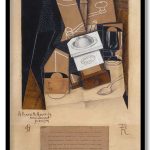
Juan Gris turned the everyday table into geometry. Born in Madrid in 1887, he moved to Paris at nineteen. He became the most methodical of the Cubists, building his still lifes from flat colour and ruled diagonal planes. Guitars, coffee grinders, carafes and newspapers recur across the work. On a wall these prints hold their shape from across a room, and reward a close look at the joins.
Juan Gris was born José Victoriano González-Pérez in Madrid in 1887. He reached Paris in 1906 and took a studio in the Bateau-Lavoir, the building where Picasso worked. Gris came to Cubism late and pushed it somewhere new. Braque and Picasso worked outward from the object. Gris often began with the grid and let the guitar or the wine bottle emerge from it. Portrait of Pablo Picasso, painted in 1912, made his reputation. By the 1920s his palette had opened into warm ochre, blue and grey. He died at Boulogne-sur-Seine in 1927, aged forty.
The range covers the still lifes Gris is known for. Coffee grinders, carafes, playing cards, sheet music, and the tabletop seen from two angles at once. The Musician's Table and Carafe, Glass and Packet of Tobacco sit near the more abstract guitar studies. Some prints are almost monochrome, worked in black, white and grey. Others carry the fuller colour of his later Paris years.
Gris suits rooms with straight lines. One large print reads well above a low sideboard or a desk. There the ruled edges of the painting pick up the edges of the furniture. A row of three smaller pieces works over a dining table. The muted browns and greys settle against off-white walls, teak and brass. For something livelier, hang a Gris still life beside Art Deco or geometric prints in a matching frame finish.
Every artwork here is an archival print, hand-framed to order and delivered ready to hang — made in India.


![Damier et cartes à jouer [Checkerboard and playing cards] by Juan Gris (1915)](https://images.bestofbharat.com/2023/11/HGGL-ANC-01-1438-1-450x450.jpg)
Wall Art
by Juan Gris