Free Shipping across India
What can we help you find?

Paul Cézanne spent his last decades painting the same hill, the same apples, the same card players, looking for the solid form underneath. His brushwork is blocky and deliberate, colour laid in patches that build depth without hard outlines. Matisse and Picasso both called him a starting point. On a wall the collection reads calm and earthy: ochre, slate blue, pine green, landscapes that settle a room.
Paul Cézanne (1839-1906) was born in Aix-en-Provence and painted there for most of his life. He showed with the Impressionists early on, then moved away from their loose light towards something firmer. Cézanne built pictures from planes of colour, treating a mountain, a jug and a folded tablecloth with the same structural attention. Mont Sainte-Victoire he painted more than thirty times. The Card Players series came from farmhands on his family estate. His late work opened the door to Cubism.
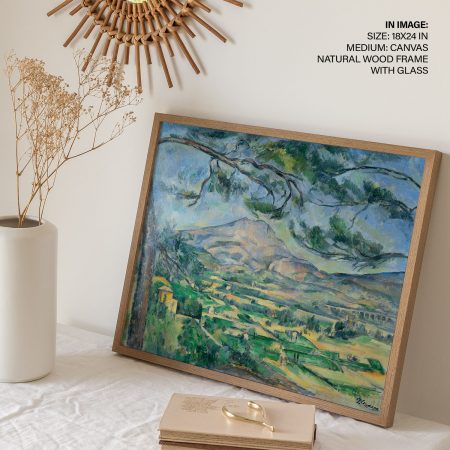
Landscape is the biggest part of the range: Mont Sainte-Victoire, the avenue at the Jas de Bouffan, roads near Pontoise, forest interiors and river banks. The still lifes follow, pitchers, fruit and the skull studies. The Card Players is here, along with a large flower piece. Colour stays in a narrow band of ochre, olive, terracotta and blue-grey, which makes the prints easy to hang together.
The muted palette works in rooms that already have texture: linen, jute, unpolished wood, lime-washed walls. A Mont Sainte-Victoire print over a bed or a long sofa holds the room quietly. Still lifes belong in a dining room or kitchen, hung at eye level where the fruit reads properly. Two or three landscapes in matching pale wood frames make a good stair wall. Cézanne pairs easily with plain modern furniture.
Every artwork here is an archival print, hand-framed to order and delivered ready to hang — made in India.