Free Shipping across India
What can we help you find?
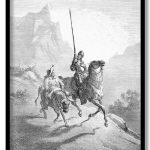
Gustave Doré illustrated the books everyone knew: Dante's Inferno, Don Quixote, the Bible, Paradise Lost. He engraved on a heroic scale, filling wood blocks with storm light, crowds and shadow. The pictures are dramatic and strangely modern, closer to cinema than to painting. On a wall they hold attention in the way a single strong photograph does, and they suit rooms with darker paint and low lamplight.
Gustave Doré (1832–1883) was French, born in Strasbourg, and working professionally as an illustrator by fifteen. He produced designs for Dante's Divine Comedy, Don Quixote, Milton's Paradise Lost, the Bible, Perrault's fairy tales and Coleridge's Rime of the Ancient Mariner. His London: A Pilgrimage recorded the poverty of the Victorian city. Doré also painted and sculpted, though the engravings carried his name across Europe and America.
The range is built on the engravings. There are Don Quixote and Sancho setting out, the wrestle of Jacob, and scenes from Paradise Lost. The Vision of Death sits alongside the allegory known as The Enigma. Most of it is black, white and grey, worked in fine parallel lines. Doré worked with engravers who cut his drawings into the block, which is why the line is so even. Biblical subjects sit alongside landscape, myth and gothic invention.
Black-and-white work is easy to place and hard to date. A single large Doré above a fireplace or a bed gives a room its centre. Two or three in a vertical stack suit a narrow hallway. The tonal range flatters grey, charcoal and deep green walls, and the prints sit comfortably next to books, brass and dark wood. Keep frames plain: black or dark walnut, with a white mount to hold the light around the image.
Every artwork here is an archival print, hand-framed to order and delivered ready to hang — made in India.
